BY CLIFF SMELLEY
Think of children’s lives as jigsaw puzzles. If pieces are missing, the picture is incomplete.
Edrick Hamilton has been attempting to supply the missing pieces to young lives as part of hits 12G Mentoring program, which is celebrating its 10th year of existence.
Hamilton hadn’t planned on creating a mentoring program, but it was something he believed he had to do when he looked around at his community. Children, whether they were raised two parents, single parents, grandparents, foster parents or older children, needed more guidance and support.
“Those kids had areas to grow in and lessons to learn,” Hamilton said. “Those kids all had pieces missing to their puzzle of life. I wanted to be a role model in their village, to help children find the missing puzzle piece of life.”
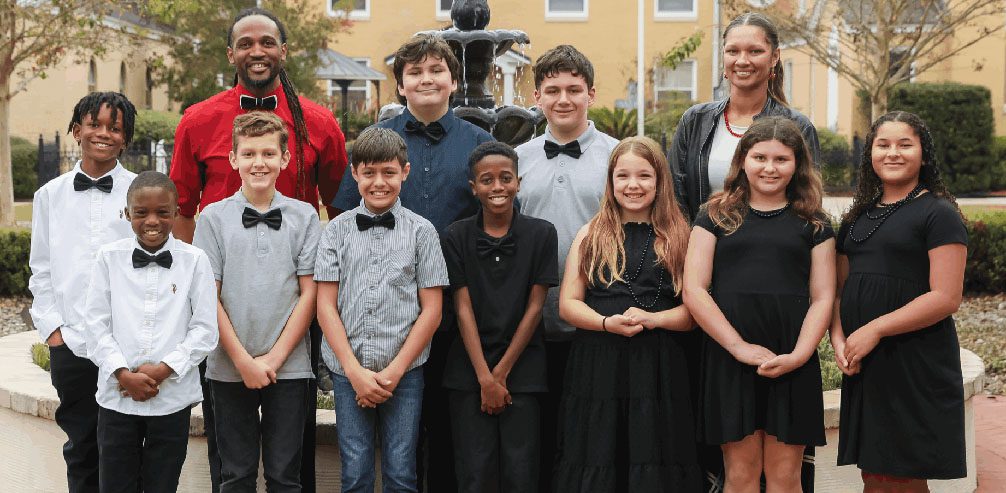
That led to the creation of the 12 Guys in Bowties and 12 Girls in Pearls mentoring program at Southside Elementary School, where Hamilton worked. The program (also known as 12G Mentoring), which is for fourth-eighth graders, is open to public-school students in Bradford and surrounding counties, private-school students and home-school students.
Hamilton said 12G Mentoring is designed to build confidence and character in its members.

“The goal of this program is to help the mentees develop cognitive skills in order to strengthen the mental process of making the right decisions, analyzing and solving problems to overcome obstacles,” Hamilton said. “To help the mentee learn specific skill sets in order to develop him or herself, add value to their community and progress on his or her path of becoming a respectful and responsible adult. To help the mentee develop networking skills to be able to work more effectively in groups. To help the mentee build character through practice of good morals and ethics.”
Students in the program meet weekly during the school year, discussing such topics as self-respect and awareness, responsibility, nonviolent defense of ourselves and others, caring for ourselves and others, and community awareness.
“Our students must dress up and wear their bowties and pearls during our weekly meetings,” Hamilton said.
Meetings are 2:30-6 p.m. on Wednesdays, including time for homework, reading and social-emotional learning.
Those in the program have their school attendance, behavior and grades tracked, with the goal being that they improve in all three areas.
“If our members are carrying themselves correctly each and every day, setting good examples and being the role models that we are teaching them to be, maybe the remainder of our student body will try to match them or mirror their actions,” Hamilton said.
The program also gives children the chance to participate in at least 10 community service projects eac year.
Road to mentorship
Hamilton said he enjoyed playing teacher when he was a child, with his family members being his students.
“Over time, I eventually moved up to playing the principal and enjoyed delegating,” Hamilton said.
Hamilton has a heart for both children and animals. He attended Santa Fe College with the goal of earning an AA degree in veterinary medicine and worked at Starke’s Town and Country Vet Clinic. He also worked at an after-school program

called Prime Time that was held at a church in Gainesville.
“The after-school program was free of charge for the kids,” Hamilton said. “Kids were handpicked by their lack of resources, behavior, grades, family dynamic and environment and if they were fostered.”
Hamilton’s involvement with youth also included working at summer camps and for YMCA programs.
A woman who volunteered with the Prime Time program watched how Hamilton interacted with children and kept telling him he needed to go to school to become a teacher.
“Each time, I said, ‘No.’ I thought I was content with just working at after-school programs and summer camps,” Hamilton said.
Yet as time went by, the woman’s words to Hamilton changed the course of his life.
“I would think about how I always liked to play teacher growing up and about all of the jobs that I had working with children,” he said. “I ended up attending Jacksonville University and changed my study to Elementary Education.”
During his studies, Hamilton began substitute teaching at Southside Elementary School, which eventually led to him being offered a full-time job there.

“By this time, I came to the conclusion that I enjoyed the mentoring of life skills and building healthy, positive relationships with the students more than the classroom-educational part,” Hamilton said.
He told the Southside principal that one of his stipulations for accepting the full-time position was that he’d be allowed to start a mentoring program.
Thus, 12G Mentoring was born, starting in Hamilton’s second year of full-time teaching.
Tomorrow’s leaders
Hamilton will tell you that 12G Mentoring doesn’t consist of children. Rather, it consists of the leaders of tomorrow. That’s why the program is all about helping today’s children reach their future potential.
He believes 12G Mentoring differs from other mentoring groups because of the various concepts that children are exposed to, such as growth mindset, attire, professionalism, positive grades, positive attitude, positive behavior, networking, grief, building on struggles and weaknesses, building positive characteristics, correcting misbehavior, life skills, solving life problems, fixing real-world situations, self-confidence, social/emotional learning, future finances, taking advantage of opportunities and setting goals.
In other words, the focus is on the whole child.
Does 12G Mentoring make an impact? Hamilton will tell you it does because he gets to witness it firsthand.
“What I am most proud of when it comes to 12G Mentoring is witnessing the growth of each and every one of the mentees at the end of the year,” Hamilton said. “The mentees come in with one mindset and leave with assets that they will have access to for the rest of their lives.”
Hamilton shared a letter he received from a parent of twin boys who were part of the mentoring program. The parent wrote that one son learned maturity, respect of others and self-respect, while the other son, who was quiet and reserved,

flourished in many ways and was recognized for his hard work and kindness.
“The positive-behavior reinforcement is something we need more of in all communities,” the parent wrote, adding that her sons “had opportunities to volunteer and help others and learn to work as a team.”
As a result, the parent said her sons became “stronger, young men.”
“Being a working, single mother of four boys — all very close in age — we are not always able to participate in volunteer and community service,” the parent wrote. “Through your program, they were able to spend more time helping others and our community and learning positive life skills. They learned the values and lessons that I want them to have in life and will benefit them in the future.
“This program has been a blessing.”
Reaching just 1 child equates to success
Hamilton said when he was in graduate school, he learned that the goal of education is to teach and reach every student, regardless of abilities or disabilities. Therefore, his goal with 12G Mentoring was to affect positive change in every member.
When the program first started, Hamilton selected students who were the worst-behaved among their peers, those he described as “followers,” who were easily persuaded by their peers and those who were model students that any teacher

would want in their classroom.
Hamilton came to learn that the goal of positively impacting every student in 12G Mentoring was unattainable.
“The first two years I struggled with knowing that I did not change every student and mold them into community minded leaders,” he said.
Adding end-of-year surveys and program exit interviews made Hamilton aware that even though 12G Mentoring wasn’t changing every member, it was changing some.
“Listening to the testimonies of some parents explaining the growth and the change of mindset of their child opened my eyes and brought peace to my heart,” Hamilton said. “Listening to some of the students tell me how the program has changed their lives for the better meant the world to me. It was the motivational drive I needed to continue to put in the unwavering time and effort to keep the program going year to year with continuous improvements.
“I was satisfied with just knowing that the program I created made a positive difference in at least one child each year.”
Hamilton said that change of mindset led to the program growing and excelling in its mission. One area of growth is the program now partnering with Bradford County 4-H, which provides children with more opportunities for leadership and personal development.
“The 4-H club model provides an excellent forum for our student to experience, practice and effectively use life skills that will allow them to be successful in living productive lives,” Hamilton said. “Leading or participating in club business meetings gives our students opportunities to plan, evaluate, discuss ideas and set goals. The basic parliamentary procedure for our 4-H club business meetings adheres strictly to Robert’s Rules of Order.”
Going into education and creating a mentor program may not have been part of Hamilton’s plan at first, but now he’s all in, willing to do his part to help young people.
“Our youth are our future,” Hamilton said. “I will sacrifice my lifetime to ensure that they are given the best mentorship possible to succeed.”