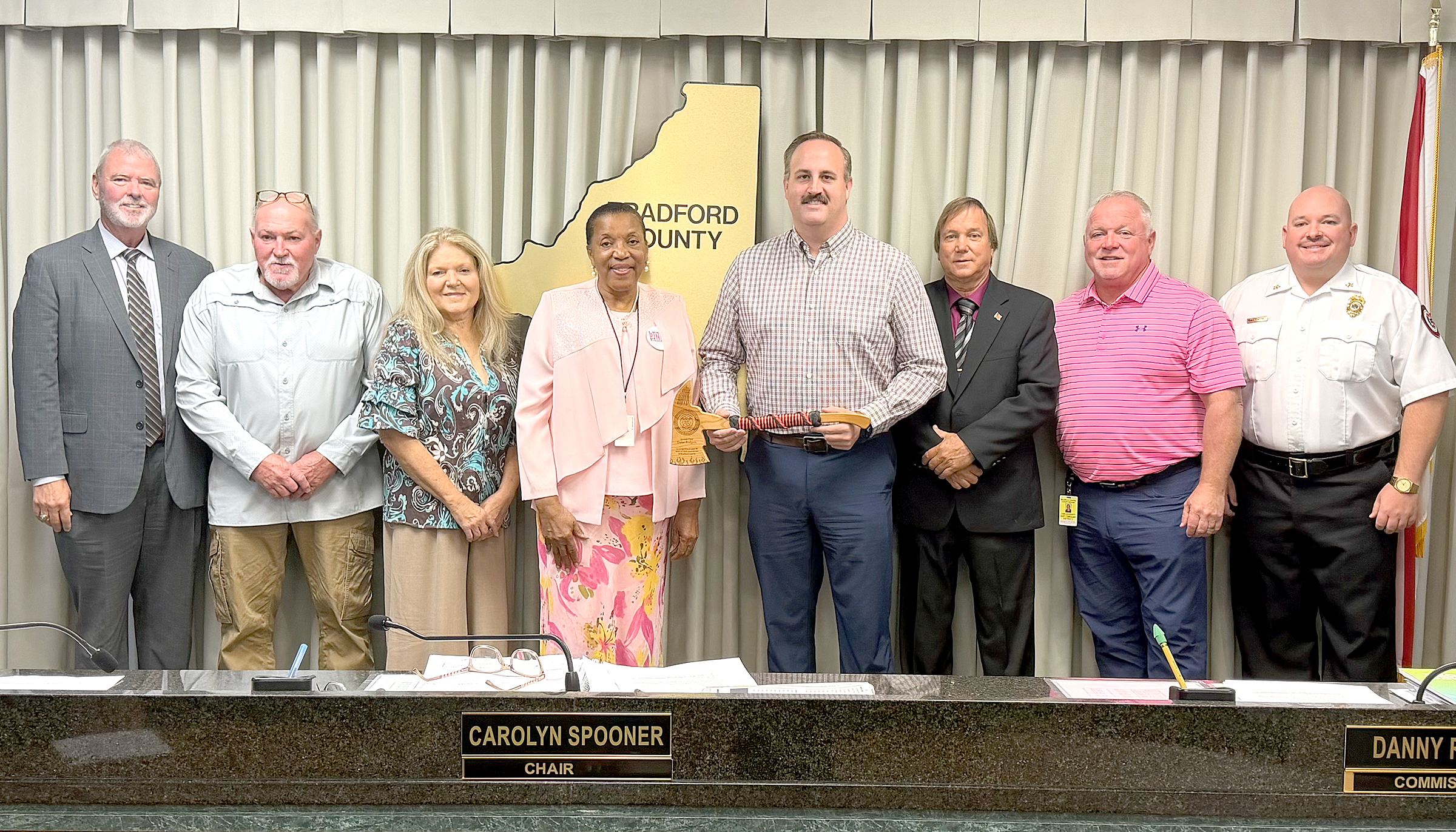
Starke adjusting water and sewer rates for the future

BY MARK J. CRAWFORD

Telegraph Editor

STARKE — The need to repay federal debt on a new sewer plant, fund ongoing and future maintenance of the system, and raise revenue for other services is behind a proposed increase in Starke’s water and wastewater rates.

Currently Starke charges the same base rate of $17.37 to in-city customers for one gallon of water or over 200,000 gallons. Billing differences are based on a increasing variable charge for total usage, ranging from .089 cents to .32 cents per gallon. Similarly, the wastewater charge is a base rate of $31.29 plus .309 cents to 1.192 cents per gallon.

Mullins said Starke is in the middle of the pack when ranked against other nearby municipalities. Starke charges residents $20.04 for 3,000 gallons of water, compared to $14.22 in Green Cove Springs, $15.50 in Lake Butler, $16 in Lawtey, $23.32 in Orange Park, $29.84 in Lake City and $39.02 in Hampton.

After the tedious process of sorting through one month’s bills, the manager’s office found that most waste and wastewater residential and commercial customers consumed no more than 3,000 gallons per month. With the exception of commercial sewer accounts, the majority are under 2,000 gallons.

Mullins then looked at the annual revenue for each category, water and sewer, residential and commercial. Residential water usage generated $568,506 last year, residential wastewater generates $1.04 million, commercial water generates $343,300 and commercial wastewater generates $781,674.

Consulting with the city’s engineers and accountant, the city needs $480,000 a year to cover debt from the sewer plant upgrade, $300,000 for annual maintenance and infrastructure, $250,000 a year to make up for revenue shortfall,l and $150,000 a year to transfer from water and sewer into the general fund to cover general government costs. 

Based on that information, Mullins proposed:

—charging $20.84 cents for 0-2,000 gallons of water per month. This is $3.47 more than the current base rate.

—charging an additional $6 for each 1,000 gallons of usage.

—charging sewer customers 150% of their water usage charge.

—charging a minimum late fee of $20 or 10% of the bill, whichever is greater.

—increasing the cutoff fee from $15 to $20.

According to the city manager, this would raise more than $1.17 million in additional revenue.

The scenario saves money for residents using 2,000 gallons of months or less, encouraging conservation. The combined water and sewer bill would be $52.10 compared to the current charge of $56.62. 

Those using more would pay more. At 3,000 gallons the monthly combined charge increases from $60.60 to $67.10, and at 4,000 gallons the bill would increase from $64.58 to $82.10. 

Implementation of the rate and structure changes will take place over three to four months. The commission voted 4-1 to proceed, with Commissioner Danny Nugent dissenting. He said it was unfair to expect customers to take on the additional burden of funding payback on loans that resulted from the city dragging out maintenance and upgrades. Since the new sewer plant was proposed the cost has increased from $18 million to more than $20 million, he said — even more money that the city doesn’t have to fund the plant.

“I believe some of this should be our responsibility to work it out of our budget to pay off some of that, so we don’t have to put more burden on the citizens,” Nugent said.

Commissioner Scott Roberts said Starke isn’t in this position because of an increased project cost, half of which is being funded with grant dollars. The city has been behind in collecting revenue to support its utilities, whether it be vehicle and equipment purchases or infrastructure repair. 

One result is that the city is under multiple consent orders from the Florida Department of Environmental Protection to address infrastructure failures that threaten public and environmental safety.

“How do you address a deficit without affecting rates?” Roberts asked. 

Nugent suggested increasing the bottom range from 0-5,000 gallons a month, but had to agree this would not raise the needed revenue. Rather than “monkey” with the numbers, Roberts said they should recognize that the proposal already benefits the low-income and low-consumption customers.

“They’ve been monkeyed with enough,” Commissioner Wilbur Waters agreed.

Plus, Commissioner Shannon Smith pointed out, they are incentivizing conservation.

“We cannot keep operating in the red. It’s not fair to the citizens,” Smith said.

Nugent asked about postponing future projects to offset current needs, but Utilities Director Scott Anaheim said the city has been on “run to failure mode.” There are no projected projects in place, because there is no funding for them. The rate increases are designed to allow the city to set aside money so he can implement his five-year capital improvements plan. This affects other department plans as well. The city cannot proceed with street work if it doesn’t have money to take care of the utilities at the same time.

Costs will compound over time, Mullins said, as will concerns for public safety. 

“So that’s the need for this. That’s the push for new rates. That’s the push for running it like a business,” he said.