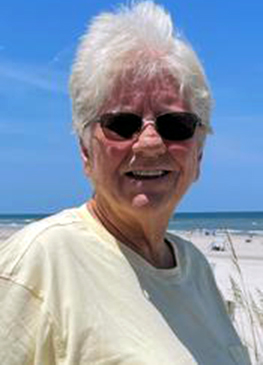
Bradford County lost a resident with a true servant’s heart with the passing of Arley McRae on Sept. 27.
McRae, 91, dedicated his life to serving his country in the Air Force, being instrumental in upgrading technology related to nuclear bombs and smart bombs, and then turned his efforts toward serving his community after his military service, working with such organizations as Habitat for Humanity and Bradford County’s food pantry, which now bears his name in recognition of his efforts. McRae also served as a Santa Fe College trustee.
The following information and quotes were previously published in the Telegraph-Times-Monitor as part of three stories written by Mary W. Bridgman, Cliff Smelley and Tracy Lee Tate.
Early life
Although McRae is a fifth-generation Bradford Countian, he was born in Lakeland, where his parents — Wesley and AnnaMae McRae — were employed in the citrus industry during the Depression.
“I was named after my paternal grandparents,” McRae said of his unusual first name. “He was named Harley, and she was Ardelia (who at one time wrote for the Telegraph). My parents just combined the two names and got Arley.”
The family moved back to Bradford County when McRae was 6. He attended the three-room Rising School, a three-room schoolhouse, for grades 1-8 and then went on to Bradford High School.
With a father who had played semi-pro baseball, McRae was interested in sports. He played football and baseball and ran track.
McRae graduated from BHS in 1952. He attended the University of Florida on a football scholarship as a wide receiver/defensive back, majoring in Physical Education and earning a bachelor’s degree in 1956.

Air Force
McRae’s interest in flying began early, nurtured by photos of World War II airplanes that appeared on the back of boxes of Kellogg’s Pep cereal.
“I cut those out, had a big collection of them during the war,” he said.
In 1942, one of those warplanes literally fell from the sky and crashed right across the road from his home, while his mother and a friend were sitting on the front porch shelling peas. The plane caught fire and caused the live ammunition it was carrying to go off.
Although one of the crew — its tail gunner — perished in the fire, that didn’t quell McRae’s interest in flying.
“It made me more determined than before,” he said. “I didn’t think about crashing.”
After a brief stint as a high school coach after graduating from UF, McRae began his Air Force career. He earned his wings in 1958, graduating number three in his class of 50.
At that time, there wasn’t a war going on, so pilots were not in high demand. McRae was able to continue his training. During an air-gunnery exercise, his plane was hit by another, which took off his left wing. Thrown from the plane, McRae was still in his seat. He pulled his parachute prematurely, which could have caused the chute to become entangled in the seat and cost him his life. Instead, the seat caught on his boot, and though the landing was rough, he survived.
“With the health and physical education training I had, I was able to cut my parachute and bandage myself,” McRae said.
The crash occurred at 10:10 a.m. By mid-afternoon, the rescue team had not found McRae or the other pilot. One of their classmates told the crew they were looking in the wrong area and went and found them. He then recruited a helicopter pilot and a doctor to make the rescue despite unfavorable weather conditions.
“I’m very thankful they got us,” McRae said.
After recovering, he spent several years flying in Europe during the Cold War, on full nuclear alert. By 1964, McRae had achieved the rank of captain.

U.S. involvement in Vietnam was escalating. McRae became involved in determining where its planes should be located. Later, he was assigned to Ubon, Thailand, and flew 133 combat missions — more than the 100 normally required of pilots. He was awarded the Silver Star, the third highest military decoration for valor that can be given to any person serving in any capacity within the U.S. armed forces.
After his tour of duty in Vietnam, McRae was asked by the Air Force to upgrade the technology and training in its planes destined for Southeast Asia. He pioneered the Smart-Bomb program, which dramatically reduced casualties, both civilian and military. The result was much better accuracy, with fewer airplanes, pilots and bombs — and casualties — required for the same job.
Later, McRae was called on to implement the same technology in nuclear bombs. That assignment propelled him into the highest circles of the Air Force, resulting in his assignment as commander of Elmendorf Air Force Base in Alaska for three years and then Luke Air Force Base in Arizona for four years.
While at Luke, McRae rebuilt the facility, removing more than 100 World War II trailers and building permanent structures for the workers on the flight line. Luke went from having 58 percent of its planes in commission to 95 percent and became the number-one military base in the country.
When asked about the sacrifices his military service required of him, McRae said he put his personal life on hold for the military, deferring marriage and a family until he was in his mid-40s.
McRae retired from the Air Force as a full colonel and eventually moved back to Bradford County in the early 1990s.

Community service
Upon his return to Bradford County, McRae re-met the woman who would become his wife — Gladys Thomas, whom he had known in high school. When he became reacquainted with her in 1992, she had just lost a son — Brian Bundy Thomas — in an automobile accident. At the time, she was raising three children. The couple started dating and were married in 1994.
The couple raised Gladys’ children — Maria Thomas Kish and Barry Thomas — as well as partly raising McRae’s son from a previous marriage, Wayne Robin Story-McRae.
Living in Bradford County, McRae became involved as an elder at First Presbyterian Church of Starke. Through that association, he became involved in the Bradford Food Pantry, where he eventually became director. He also became executive director for the local branch of Habitat for Humanity, which built five homes during his tenure.
In 1997, McRae also became affiliated with The Children’s Table in the Levy County/Bronson area. The Children’s Table not only collects food for those in need, but its members go out and glean the fields of local farmers to collect food that would otherwise be wasted.
McRae is a strong and outspoken advocate of education as a means of fighting poverty and improving lives. In 1999, Gov. Jeb Bush appointed him a trustee for Santa Fe College, a position he still holds after re-appointments by two more governors. He was selected as Florida State Colleges Trustee of the Year in 2014. In 2018, he was named Santa Fe’s first trustee emeritus.
In another means of supporting education, McRae and his wife have hosted two exchange students from Brazil — brothers Diego and Bruno. Both have stayed in touch with their host family and have gone on to be successful and accomplished adults. The McRaes are very proud of them.
On Aug. 21, 2013, McRae had a double stroke in the middle of the night — one right after the other.
“I felt a tremendous tension in my whole body, and I went completely rigid,” McRae said. “When the tension released, it felt like my leg had been dislocated. The second time, my hand felt like it was semi-truncated. I went back to sleep or went into a semi-conscious state where I was not aware of what was happening.
“When I woke up in the morning, I went down the hall to the bathroom and started into my morning routine. I showered. Then, when I was drying off, I lost the left side of my body. I just wilted to the floor, totally limp.”
The strokes, which left him confined to a wheelchair, affected his involvement with the food pantry, but he was able to attend the grand-opening ceremony held in September 2017 when the food pantry moved into its current building adjacent to the fairgrounds (the former Gold Key building). In speaking at the event, McRae quoted Matthew 25:35-40 and encouraged those in attendance to also go home and read it themselves: “For I was an hungered, and ye gave me meat; I was thirsty, and ye gave me drink; I was a stranger, and ye took me in; Naked, and ye clothed me; I was sick, and ye visited me; I was in prison, and ye came unto me. Then shall the righteous answer him, saying, Lord, when saw we thee an hungered, and fed thee? or thirsty, and gave thee drink? When saw we thee a stranger, and took thee in? or naked, and clothed thee? Or when saw we thee sick, or in prison, and came unto thee? And the King shall answer and say unto them, Verily I say unto you, Inasmuch as ye have done it unto one of the least of these my brethren, ye have done it unto me.”
In June 2022, McRae attended another ceremony at the food pantry. He was surprised when it was revealed that the food pantry was being renamed the Colonel Arley W. McRae Bradford Food Pantry.
Betty Warren, a food pantry board member, described McRae as the backbone of the organization, saying, “I’ve been at the pantry a long time, and I’ve worked closely with Arley for many years. I don’t think the pantry would exist — definitely not as it does today — if it had not been for Arley.”