
Dan@BcTelegraph.com
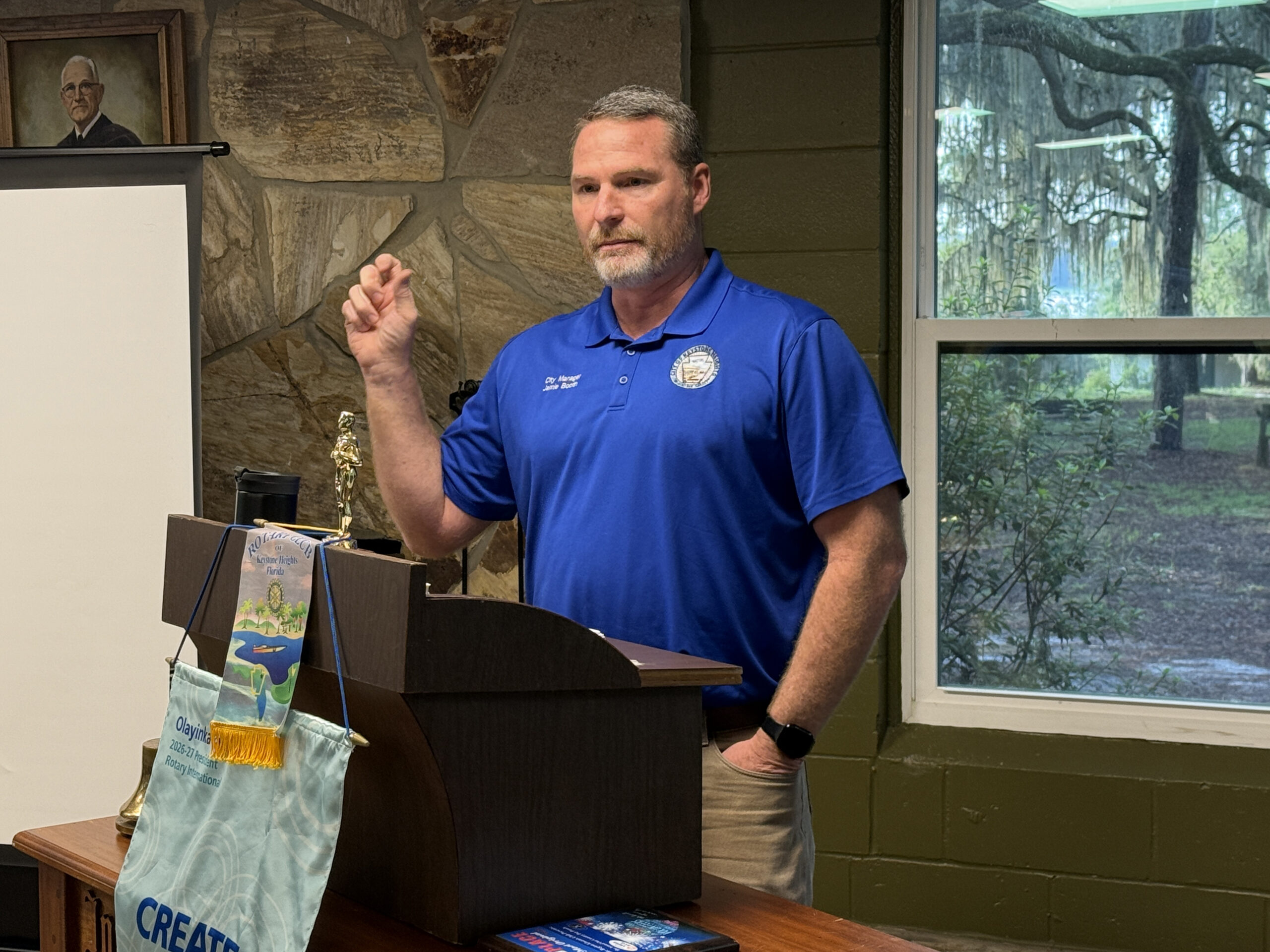
City Manager James Booth told the Keystone Heights Rotary Club that proposed Amendment 3 would reduce the city’s annual revenue by roughly $140,000 once fully implemented, prompting potential cuts to community events, economic development efforts and some infrastructure maintenance while preserving core operations.
Booth, speaking at the Wednesday, August 19 Rotary meeting, said he believes that if the amendment is implemented, the city would be able to retain its current staff, while shifting some job responsibilities.
He emphasized that city staff members are limited to providing information and cannot advocate for or against the measure. “Don’t take anything I say as being for or against the amendment,” he said. “We are legally only allowed to just inform people on what the impacts would be.”
The official said the city’s overall budget is about $1.7 million. Property taxes currently account for roughly one-quarter of revenue, or about $400,000. Amendment 3 would raise the homestead exemption from $50,000 to $150,000 in the first year after passage and to $250,000 the following year, with later cost-of-living adjustments. It would also restrict the use of remaining property tax revenue at the municipal and county levels to core functions such as public safety, retirement accounts, infrastructure and the environment.
Booth said he is just as concerned about how the amendment would impact Clay County as he is about Keystone Heights, since the city relies on the county for law enforcement and fire rescue.
The city manager said his current recommendation to the council is to eliminate city support for community events if the amendment passes and revenues drop. The city spends an estimated $35,000 to $40,000 annually on Fourth of July activities alone, including fireworks and sheriff’s office support for road closures and security. Other events, such as Boo on the Boulevard and Christmas-related activities, would also be cut. The events director position would shift fully to grant writing to help offset infrastructure shortfalls.
Additional reductions could include ending the city’s annual $10,000 contribution to a lakes account (used recently for Lake Geneva projects), ceasing memberships in economic development organizations, and trimming preventive maintenance on city buildings and sidewalks. Booth said the city would move to a more reactive approach, repairing or replacing systems only after they fail, while aiming to avoid staff reductions. Keystone Heights has about 12 full-time-equivalent employees and roughly 15 total staff members, many of them part-time.
“We think the amendment three is survivable. We can keep governance going,” Booth said. “I don’t see that we would have to let go of employees.” He noted the city’s low millage rate and lack of its own police or fire departments make the impact more manageable than for many other municipalities or for Clay and Bradford counties.
Residents of Keystone Heights would still feel effects through county services. If Clay County reduces fire-rescue capacity, Booth said, homeowners could face higher insurance costs or new assessment fees as local governments seek alternative revenue. No mechanism to make “fiscally constrained” counties or cities whole survived in the final amendment language, according to Booth and meeting participants.
In other remarks, Booth updated the group on the Black Creek Water Resource Development Project. He said recent rains allowed St. Johns River Water Management District pumps to operate at full capacity for about a week, sending water toward Lake Brooklyn and Lake Geneva. Last week, a pipe connection failed near the intersection of State Roads 16 and 21, releasing a large volume of water and damaging State Road 21. District officials said they were still assessing the situation and determining next steps; the surface appearance of repairs was visible, but a timeline for restarting the system was not yet clear.