
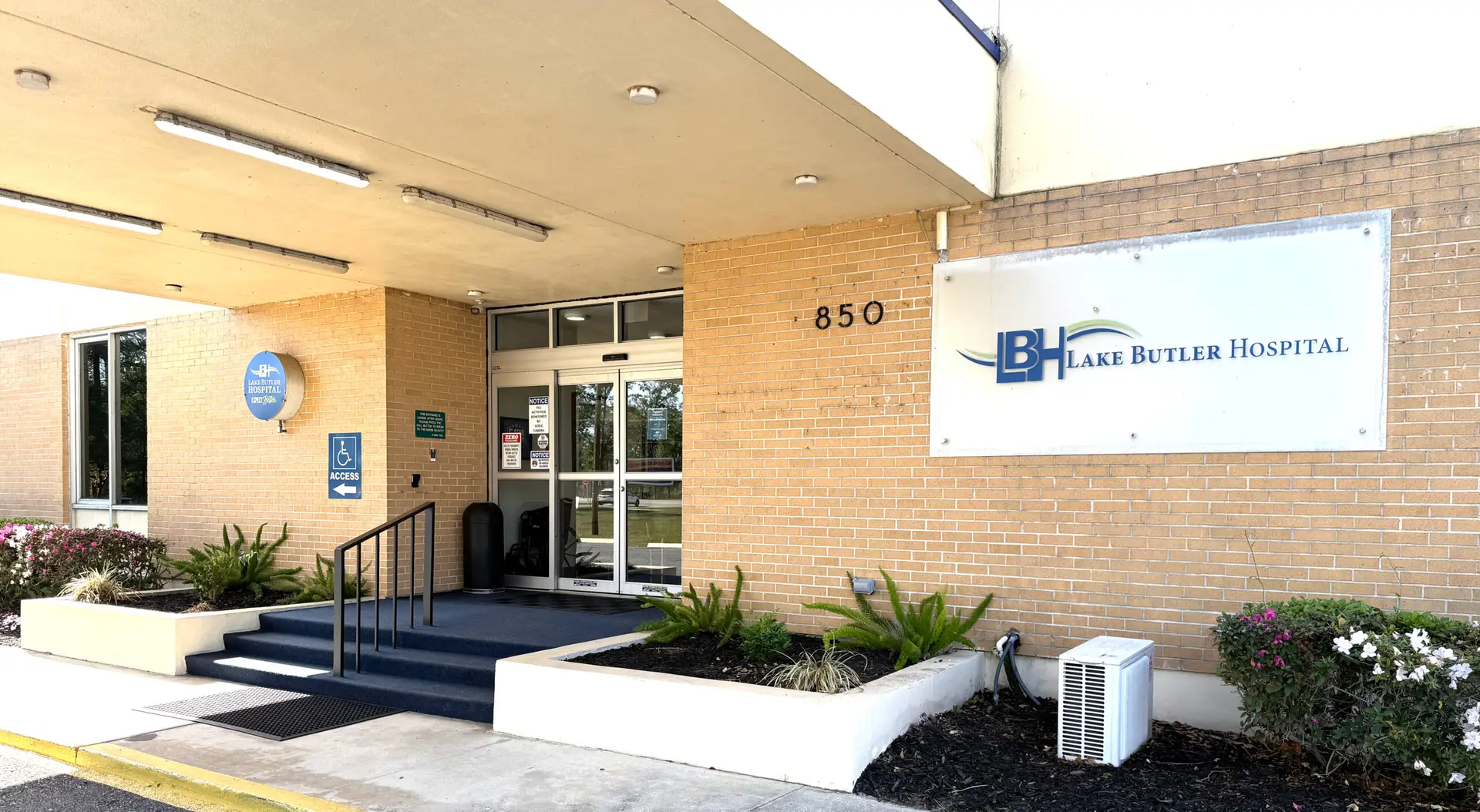
Paula Webb was 19 years old, studying accounting in Gainesville, when a roommate mentioned that a physician who had just purchased a bankrupt hospital an hour north was looking for help with the books.
That was 1984. Four decades later, Webb is no longer the young accounting coordinator trying to make sense of a failing facility’s ledger. She is the sole owner of Lake Butler Hospital, a position that, by the logic of modern American healthcare, should probably not exist.
American rural hospitals are struggling
In the last 20 years, 200 rural hospitals have closed, including six in Florida.
In North Florida, Regional General Hospital in Williston closed in 2019, Lake Shore in Lake City shuttered in 2020, and Healthmark in DeFuniak Springs closed in 2022.
Two additional facilities have converted from general acute care to offering emergency department services only: HCA Starke Emergency and HCA Suwannee Emergency in Live Oak.
A Hospital Born From Bankruptcy
The current Lake Butler Hospital facility opened in 1972, built with federal funds on what is now its present site, a replacement for a smaller predecessor hospital that had operated in a building near the county courthouse.
The facility changed hands several times through the 1970s and early 1980s, passing through independent management companies and eventually a group of local private investors who operated under the name Health America of Florida. By 1984, it was in bankruptcy.
That is when Dr. Abdel Moneim Ramadan stepped in. An Egyptian-born hand surgeon with a practice in Gainesville, Ramadan purchased the stock from the private investors and set about transforming the struggling 27-bed facility into a regional destination for hand surgery patients.
“He was an exceptional hand surgeon,” Webb recalled. “He pulled it out of bankruptcy by specializing in hand surgery. So, we did very well for quite a while.”
Ramadan built a network of referral offices in Gainesville, Lake City, Palatka, and Lake Butler itself, drawing patients from as far away as Valdosta, Georgia, and South Florida.
Webb joined Ramadan’s operation from the start, working first out of his Gainesville office before transitioning to the hospital. She rose through the organization from accounting coordinator to vice president of finance and ultimately to CFO, learning the peculiar economics of small hospital administration alongside a physician who was, by her own account, a brilliant surgeon but an inconsistent manager.
The Buyout
By the early 1990s, Ramadan was ready to retire from hand surgery. He offered his four-surgeon group the opportunity to purchase the practice and the hospital, but the deal never came together. Instead, three members of his executive management team, Webb, Pam Howard, who had been running administrative operations and whose own father had practiced medicine at the old downtown hospital, and Nancy Lane, who managed the Gainesville practice, negotiated a deal and bought the hospital themselves.
The purchase closed in 1994. A fourth partner, Becky Evans, initially joined the group but left within weeks to remain with Ramadan. That left what Webb called the three co-founders of the company operating the facility: Medlink Management Services, Inc.
The new owners negotiated to keep three of Ramadan’s four hand surgeons and continued the specialty program that had kept the hospital solvent. For nearly a decade, it worked.
Then came a string of blows that would have finished a less tenacious organization.
A Decade of Compression
Nancy Lane, one of the three founding partners, was diagnosed with breast cancer not long after the purchase and died around 1999, roughly five years into the new ownership. That left Webb and Howard.
Meanwhile, the hand surgery market was fragmenting. As the specialty expanded across North Florida and beyond, competition stiffened, and the patient volume that had sustained the Lake Butler program began to erode. The hospital’s surgeons drifted away one by one.
The last was Dr. Owen BK Osborne, who had been with the hospital since the Ramadan era. When Osborne died unexpectedly around 2008, Webb said, the hand surgery business effectively lost its anchor.
Two plastic surgeons with hand training stepped in to cover, staying through 2015. But the financial picture kept darkening. The Affordable Care Act brought Medicaid expansion to most states, but Florida declined to participate. For rural hospitals already carrying heavy uninsured patient loads, the resulting federal cutbacks to what is known as disproportionate share funding hit hard. Lake Butler absorbed a double blow: competition drained its insured volume while the federal safety net frayed.
“We were losing funding, and of course, competition was a lot stiffer, and we were losing our hand surgeons,” Webb recalled. “And then, our last surgeon unexpectedly passed away.”
In 2015, the hospital permanently closed its hand surgery program.
The Critical Access Pivot
Even before hand surgery collapsed, Webb and Howard had spotted a lifeline in the federal regulatory code. Around 2001, the hospital converted its designation from a standard general acute-care facility to a Critical Access Hospital, a Medicare classification designed to help small rural hospitals survive by providing cost-based reimbursement.
Critical Access Hospital status comes with constraints: a maximum of 25 licensed beds, and patients may not remain for more than 96 hours in acute-care status before they must either be discharged or transferred. For Lake Butler, which had 27 beds, converting meant formally banking two beds with the state of Florida.
But the designation also unlocked a program that has become the hospital’s financial backbone: the swing bed, or short-term rehabilitation program. Patients who no longer require acute care but are not ready to go home can transition to a swing bed for short-term rehab, physical therapy, occupational therapy, and respiratory therapy within the same facility.
The challenge is getting post-acute care patients from other facilities. Large hospital systems refer their post-acute care patients to their own affiliated rehab programs. Lake Butler’s answer is awareness: encouraging community members and their families to ask their physicians, by name, to refer them locally.
“You have to have the patients ask for us and request to come here,” Webb said.
What the Hospital Offers Today
Lake Butler Hospital now operates as a multi-service facility anchored by its swing bed program. Its other services include a 24-hour emergency department, which Webb said is known for fast turnaround times; the Lake Butler Family and Pediatric Clinic, a rural health clinic providing primary care; outpatient rehabilitation including physical, occupational, and respiratory therapy; a laboratory that also serves as a draw site for Quest and LabCorp orders; CT scanning capability added in 2019; outpatient imaging services including X-ray; and a cardiology affiliate, with echocardiogram capability being worked out through a partnership with a North Florida-based cardiologist.
The CT scanner in particular represented a strategic investment in the hospital’s credibility. Rural hospitals contend with a persistent perception problem, that small means less capable.
“The more we can provide those diagnostics and treatment, I think has been the [key],” Webb said. “That’s probably the most difficulty that rural hospitals have in small communities, the perception that because you’re small, you don’t have the same quality of care.”
The hospital also draws patients from outside Union County, including from Starke, Lake City, and Baker County.
COVID, Sole Ownership, and What Comes Next
In 2020, Howard retired and Webb purchased her interest, becoming the sole owner of the hospital, a transition that coincided almost exactly with the onset of the COVID-19 pandemic.
The pandemic proved unexpectedly clarifying. Webb said the community, for perhaps the first time in years, looked to the hospital with fresh eyes and recognized its value.
“I think the community shifted at that time and really recognized the value of the hospital during that whole COVID pandemic,” she said. “We started seeing more people coming to the facility.”
Webb also went through a significant personal loss in those years, with the death of her husband. She said the experience sharpened her focus on the hospital’s purpose in the community.
Now, the hospital is preparing for its most significant capital project in years: a full replacement of its HVAC system and ductwork, approved after a four-and-a-half-year regulatory review by Florida’s Agency for Health Care Administration. The project, long in the works, is a sign of an organization stable enough to invest in infrastructure.
The hospital has also recently expanded its outpatient therapy area into a larger, dedicated space.
Expect Better, 5-Star Rating
For patients accustomed to crowded, slow, and loud emergency department waiting rooms, a 40-minute drive to a paid parking lot and a 10-minute walk to the hospital, and understaffed facilities, Webb and her executive team have a message: Expect Better. That’s the tagline the hospital adopted to inform residents that they don’t have to settle for the typical big-city hospital experience.
Chief Clinical Services Officer Cynthia Coulter added that the hospital’s focus on staff education and training, quality measures, patient safety, pharmacy services, and dietary offerings to improve the patient experience has resulted in Lake Butler Hospital’s designation with a 5-star quality rating from the National Rural Rating System.
The rating is based on Hospital Consumer Assessment of Healthcare Providers and Systems scores, which are national, standardized surveys sent to patients after discharge that ask about their hospital experience, including the care they received, food quality, and interactions with providers.
‘You Have to Be in It for the Long Haul’
Webb is candid about the structural disadvantages facing an independently owned rural hospital. Provider shortages are real, the hospital’s service area is formally designated a Healthcare Professional Shortage Area, a designation the hospital leverages to offer medical school loan forgiveness as a recruiting tool. The referral pipeline for rehab and outpatient services runs uphill against systems that route patients to their own affiliated programs. The federal reimbursement environment for hospitals serving high proportions of uninsured patients remains difficult.
And awareness remains the most persistent marketing problem. Despite years of promotion, Webb says she still regularly encounters community members who do not know the hospital offers CT scanning, outpatient lab services, or rehab, or who still think of it as a hand surgery center.
“I still thought you were hand surgery,” she recalled one resident saying. The hospital closed that program a decade ago.
The philosophy Webb has built the hospital around is not a flashy one. It is, at its core, about presence and trust accumulated over decades, something she argues large healthcare corporations underestimate when they move into small communities.
“These large corporations that go into small communities and think that they can make them successful just because they have their name and the money behind it, it doesn’t work that way in the communities,” she said. “You’ve got to be there long term. You have to build that trust in the community.”
She has been there 41 years.
And counting.
