BY CLIFF SMELLEY
If a driver is impaired by alcohol, it’s pretty easy for a law-enforcement officer to determine that, but what if the driver is being affected by something other than alcohol?
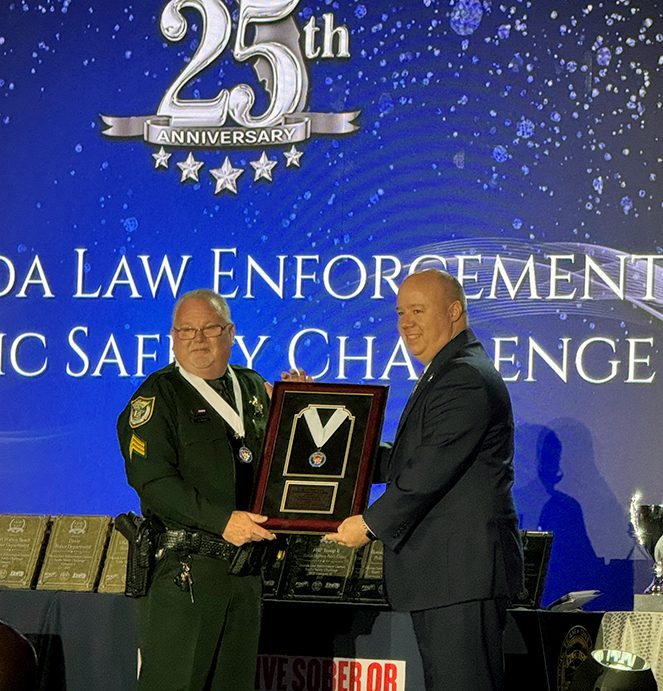
That’s not so easy, but Bradford County Sheriff’s Office Sgt. Glenn Ward has gone through rigorous training to be able to do just that. He is the office’s first-ever drug recognition expert and was recently recognized as the Florida Drug Evaluation and Classification Program’s 2024 DRE of the Year.
The award was presented as part of the 25th annual Florida Law Enforcement Traffic Safety Challenge in Orlando in July.
“It shows he’s doing his job exceedingly well,” Sheriff Gordon Smith said.
Ward, who also earned an award for impaired-driving enforcement last year, said being named the state’s DRE of the Year is a credit to the deputies who perform road stops.
“I couldn’t have gotten this without they guys,” Ward said. “You know why? They find them. They do a DUI. Then I go to do the DRE on them.”
Ward said the sheriff and his administration also deserve credit for “supporting the stuff that is a little bit out of the ordinary.”
DREs certainly aren’t ordinary. Ward said Florida has 93,000 law-enforcement officers. Only 350 are DREs. Data compiled by the National Highway Traffic Safety Administration in 2019 revealed that Florida had the fourth highest number of DREs after California, Texas and New Jersey.
DREs aren’t confined just to the U.S.
“The thing about this certification that I have is it’s international,” Ward said, adding, “I could go to England and be a DRE.”
Worldwide, less than 1 percent of law-enforcement officers are DREs, Ward said.
If one wants to become a DRE, he or she certainly has to be fully committed because it’s a difficult process.
“It’s quite the challenge to get certified in that,” Smith said.
First, someone interested in going through DRE training has to be accepted. Ward said it’s not like most certifications where you just sign up and go.
Ward said he had to take an online pre-course and then attend a two-day in-person phase. The second day of the in-person session included an exam. DRE candidates have to pass that exam to continue.
Following that is seven days of instruction, with DRE hopefuls studying from a 35-chapter book. Ward said there are several “exit points” along the way, where failure results in the end of a person’s continuation with the program.
Ward said a main test is taken at the end of the seven days. If you don’t pass, you get one chance at a retake. If you fail that, you’re done with the program.
The main test is followed by two days of practical experience at a clinic in Jacksonville, evaluating people who are on drugs or alcohol.
DREs learn seven drug categories: central nervous system depressants, central nervous system stimulants, hallucinogens, dissociative anesthetics, narcotic analgesics, inhalants and cannabis.
Ward said candidates have to be at least 85-percent accurate in their evaluations to continue with the DRE program.
Those who continue then have five months to ready themselves to take a final-knowledge exam.
“There are five parts,” Ward said, adding that one has to score 98 percent to pass. This exam has no retakes.
“The test took me nine hours,” Ward said. “They give you up to 12 hours to take it. The minimum that somebody’s completed it, I think they said, was five hours.”
All in all, the total process of getting certified took Ward nine months. He completed the training in September 2024.
“He was stressed,” Smith said. “He was like, ‘Boss, I’ve never done anything this hard.’”
In evaluating impaired drivers, Ward, as a DRE, has to go through a 12-step process, which includes such things as interviewing both the suspect and the deputy involved, conducting a breath-alcohol test, taking multiple pulse readings as well as a blood-pressure reading and examining the eyes.
“Your eyes can pretty much tell me everything,” Ward said. “They’ll give me an idea of what you’re on.”
After examination, Ward will put together a detailed report that can take him several hours. The report has to be uploaded to a national data base and approved by a DRE instructor.
“They’re trying to track all this,” Smith said. “What is really creating most of the traffic crashes on our highways?”
Ward said becoming a DRE has also benefitted the sheriff’s office with additional funding via grants he’s applied for. Some of that funding has been used to pay for overtime as the office has put additional deputies on the road.
“It’s two-fold for us,” Ward said. “Not only are we getting people off the road who are impaired, we’re putting out that presence, which also deters crime.”
Ward is passionate about helping to combat impaired driving. His father, impaired by alcohol, caused a crash that killed a father of three before Christmas.
“I just felt it was my thing, that I needed to make it up to those kids because they grew up without a dad,” Ward said, adding, “It’s been a mission for me.”
Ward said he’s conducted nine DRE evaluations this year, which he described as “a lot.”
“One the average, you do maybe six or seven a year,” he said.
Still, being recognized as the Florida Drug Evaluation and Classification Program’s 2024 DRE of the Year was something he never would’ve imagined.
“I was very shocked that I won this,” he said.