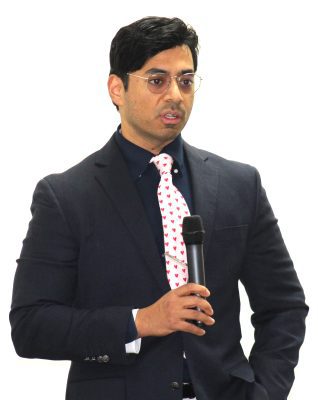
A board-certified interventional cardiologist who recently joined the Ibrahim Heart Clinic is working to bring advanced cardiac, vascular, and valve procedures to the local community — and his message to residents is clear: early detection saves lives.
Dr. Yashwant Agrawal, who goes by Dr. Yash, introduced himself and his specialties during a recent “Let’s Thrive” community health talk held at Lake Butler Hospital’s new professional center. A Michigan-trained physician who spent more than four years practicing in Arizona before relocating to Florida, Dr. Agrawal specializes in coronary artery disease, peripheral vascular disease, and aortic valve disease.
Recognizing the Warning Signs of Heart Disease
Much of Dr. Agrawal’s presentation focused on helping community members and caregivers recognize symptoms that are frequently overlooked or misattributed to aging.
“A lot of times it is just chest heaviness — something doesn’t feel right,” he told attendees. He stressed that more than half the time, women and diabetic patients in particular experience heart disease symptoms not as classic chest pain, but as discomfort in the upper abdominal area or unexplained fatigue.
He identified diabetes, smoking, age over 50, and family history of cardiovascular disease as major risk factors for coronary artery disease. For families, he noted a key threshold: men under 55 or women under 65 with a history of strokes or heart procedures are considered to have premature cardiovascular disease, making screening for other family members especially important.
“Preventative care is the best thing to do,” Dr. Agrawal said, encouraging anyone with gradual fatigue, shortness of breath, or a slow decline in activity levels to get checked rather than chalking it up to aging.
Modern, Minimally Invasive Procedures
Dr. Agrawal highlighted the evolution of cardiac procedures, noting that he performs over 95 percent of his heart catheterizations through the wrist rather than the groin — a significant improvement in patient comfort over the older approach that once required sandbags to control bleeding.
He also discussed transcatheter aortic valve replacement, a procedure for patients with severe aortic stenosis. Once exclusively requiring open-heart surgery, valve replacement can now be performed through the groin and often requires only an overnight hospital stay. “Sometimes, if it’s an early morning procedure, we even send patients home later that night,” he said.
On the topic of peripheral vascular disease, Dr. Agrawal urged awareness of leg pain, calf cramps, and non-healing ulcers as potential signs of blocked leg arteries. Smoking, he said, is the single greatest risk factor. Simple diagnostic tools, such as blood pressure checks in the arms and legs, can identify the problem early.
Atrial Fibrillation and the Watchman Device
The talk also covered atrial fibrillation (AFib), which Dr. Agrawal described as one of the leading causes of stroke. He noted that many patients with dangerously high heart rates — as high as 150 beats per minute — may feel no symptoms at all, making the condition a silent threat.
Standard treatment involves blood thinners such as Eliquis, Pradaxa, or Coumadin. But for patients at high risk of bleeding, Dr. Agrawal described the Watchman device, a small umbrella-like implant that is inserted through the groin vein to seal off the left atrial appendage, the area of the heart where dangerous clots typically form during AFib.
After about six weeks on blood thinners following the procedure, patients can transition to baby aspirin alone. “It helps a lot, especially as we all get more mature,” he said. The device is not rejected by the body and requires no anti-rejection medication.
The interactive session featured questions from audience members about family history, the relationship between diabetes and plaque buildup, and how to prevent AFib. Dr. Agrawal emphasized that uncontrolled blood pressure, obesity, sleep apnea, and lung disease can all contribute to the development of atrial fibrillation.
A Commitment to Accessibility
Throughout the talk, Dr. Agrawal reinforced his availability to the community. He encouraged attendees to send referrals, share EKGs, and reach out with questions. “I’m going to be available basically all the time,” he said.
The Ibrahim Heart Clinic has offices in Starke, Jacksonville, Fleming Island, St. Augustine, Palatka and Waycross, Georgia.