BY DAN HILDEBRAN
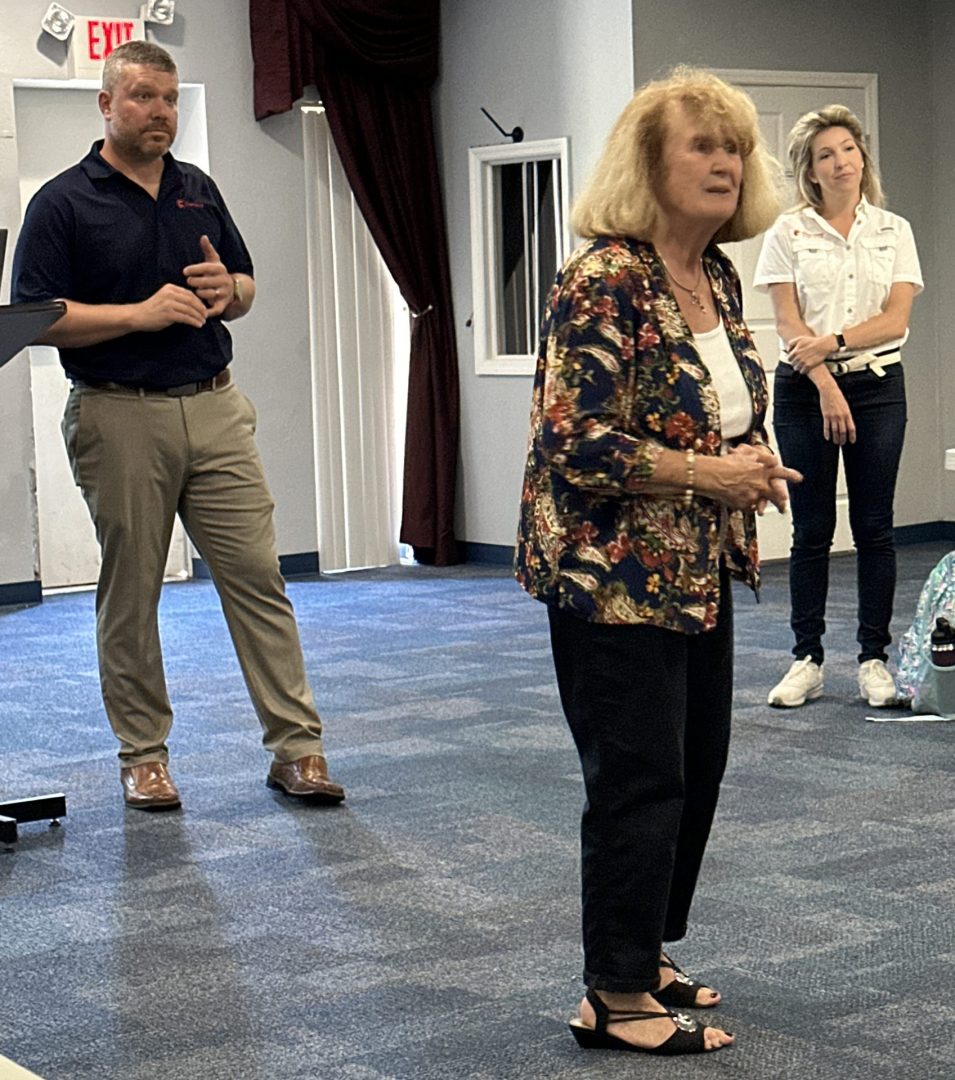
The Northeast Florida Economic Development Corporation and the Northeast Florida Chamber of Commerce sponsored a lunch and learn about Chemours.
The company’s Florida Operations Leader, Jason Geiger, said Chemours’s $20 million annual payroll supports 231 employees, of which 124 live in Bradford County.
He added that Chemours operates three business segments. Its advanced performance materials unit markets resins, the nonstick coating Teflon, lubricants and flouros: materials that can withstand heat.
The company’s thermal business unit manufactures refrigerants like freon and fire suppressants.
Its titanium technologies business mines, manufactures, and sells titanium dioxide, which is used as a whitening agent in many products.
Not only for paint
The Trail Ridge operation mines the raw materials for titanium dioxide.
“It’s not only (for) paint,” he said., “but it goes into plastics and laminate paper, all kinds of other things. Lots of things that it makes white.”
He added that the chemical is used extensively in food packaging to prevent ultraviolet rays from reaching products from milk to potato chips.
He said the company now operates two mines in Baker County near Maxville, a mineral separation plant north of Lawtey, a mineral separation plant at Trail Ridge within Camp Blanding, and a new mine started in 2022 called Trail Ridge South.
Geiger said the Trail Ridge plant, within Camp Blanding, is the longest-running zircon plant in the world.
“They started building it in 1948, and it’s been running since 1949,’ he said. “We still have original equipment from 1949 running in that plant.”
The manager said that since the manufacturer of some of the equipment within the plant went out of business years ago, Chemours has to fabricate its own replacement parts.
From toilet seats to dinner plates
Geiger said the Northeast Florida plants produce around 10% of the company’s raw materials used in its TiO2 products. Chemours buys the other 90% from Africa, Australia, and the Ukraine.
He added, however, that the best quality heavy minerals originate locally.
Geiger said some titanium is milled into a fine flower-like substance called opacifier.
“And then that goes into the glazes that make your toilets white, your sinks white, even dinner plates and coffee mugs,” he explained. The manager added that the Florida and Georgia zircon opacifier gives off a slight blue hue. In contrast, the opacifier made from zircon in the rest of the world emits a yellow tint.
“So, the most interesting thing about this fact is all of us men in the room, we can’t tell the difference,” he said. “We can’t see it, but you ladies have more rod cells or cone cells. I can never remember which, but you have more rods or cones in your eyes, and you can actually tell the difference. If I showed you a white tile that was made with Australian zircon and one that was made with ours, you would know that this one was the one from the U.S. because it’s got a slight blue tint.”
New technology allows more mining
Senior Geologist Kristen Woods added that the Trail Ridge runs from Starke to Jesup, Georgia and that the company mines heavy minerals from the former sand dunes, including zircon, ilmenite, and rutile.
“It’s about one to two kilometers, east-west, 160 north-south,” she said.
Woods added that for 70 years, miners have extracted heavy minerals from the area using a dredge operating along the top of the ridge.
Now, mobile mining technology allows Chemours to mine on the slopes of the ridge, around and between wetlands, and in other areas inaccessible by the dredge.
“It’s not quite as economical,” she said of the dump-truck-sized units compared to the dredge, “but it’s better in the fact that we can avoid wetlands, and we can get into little, tiny pockets that we couldn’t dream of getting with a dredge. So, it’s got good and bad points.”