Clay Behavioral provides mental health services in the Lake Region

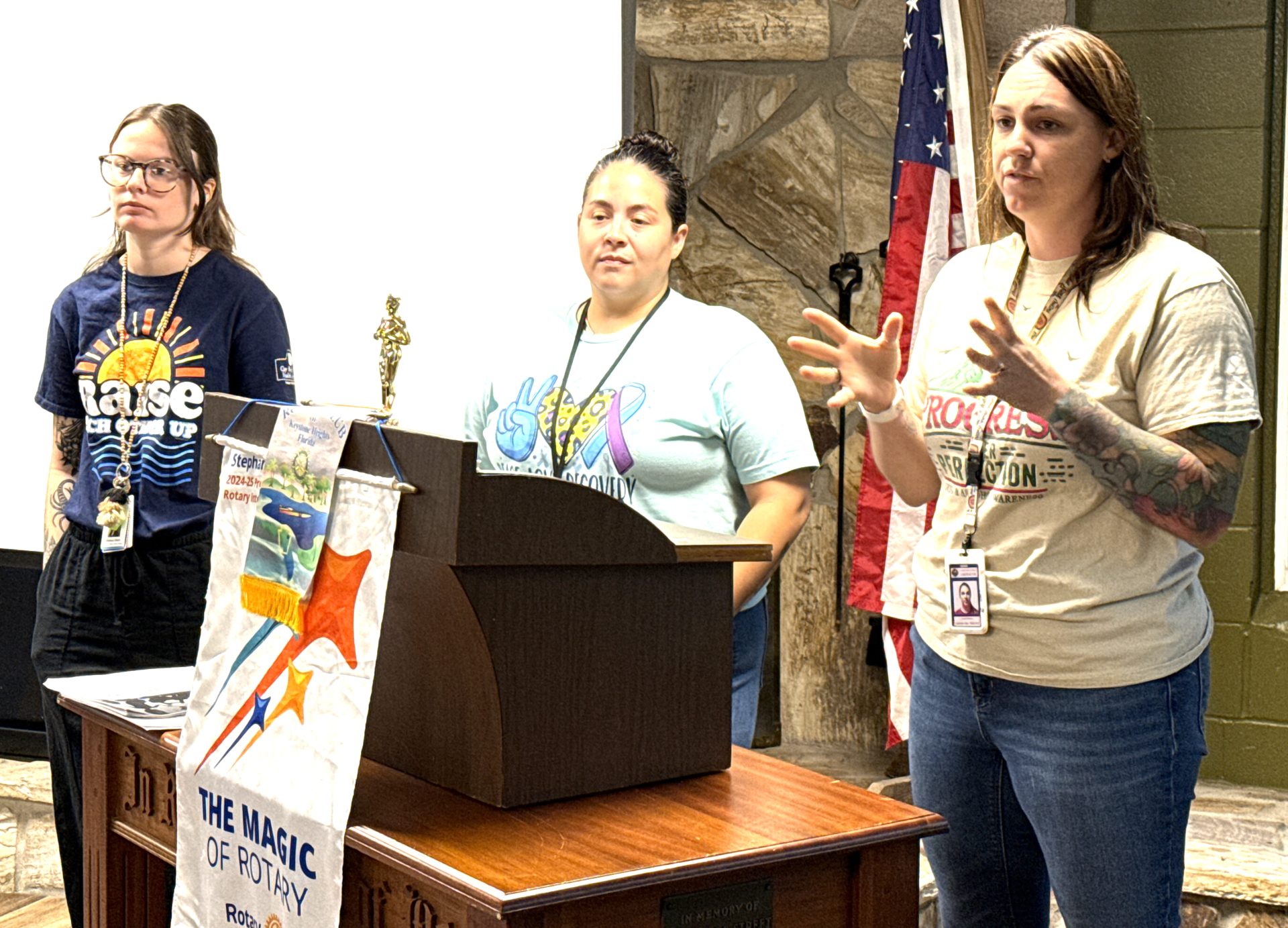
(L-r) Khelsea Boyd, Debbie Carter and Crystal Riviere address the Keystone Heights Rotary Club on Wednesday, September 24.

[email protected]

Three workers from Clay Behavioral Health Center spoke to a Lake Region civic group about the mental health services their organization provides to the Keystone Heights area. Crystal Riviere, Khelsea Boyd, and Debbie Carter told the Keystone Heights Rotary Club that in addition to an office on State Road 21 North, the center also treats children at McRae and Keystone Heights Elementary schools.

The trio discussed service accessibility, insurance options, outreach strategies, specific interventions for youth and adults, and current mental health trends in the community.

Riviere, who oversees the Keystone Heights office, said the 7412 State Road 21 location accepts walk-ins without a referral, and patients may be seen in person by a clinician on the same day or through a telehealth session.

The Keystone Heights office is open on Mondays from 8:45 a.m. to 11:45 a.m., Tuesdays and Fridays from 10:45 a.m. to 12:45 p.m., and on Thursdays from 12:45 p.m. to 3:00 p.m.

Riviere added that trauma, substance use disorder, and anxiety and depression are the most common conditions that the office sees.

Carter explained that fees are covered by private insurance, Medicaid, and public support the organization receives.

Fees are based on a sliding scale that considers household income and the number of individuals in the household.

The administrative assistant said patients are not required to provide proof of income.

“We trust your information,” she said. “If you meet a certain threshold, it’s very affordable. Fifteen dollars for a first assessment, $10 for individual visits, and $5 for group sessions.”

Focus on prevention

Boyd, who shuttles between the Lake Region’s two public elementary schools, said her position, and six other clinicians throughout the county, is funded through a contract with the school district.

She added that her caseload capacity is around 40 students and that her slots typically fill up after the Christmas break.

“We don’t know if that’s because things happen over the breaks or people are adjusting to the time off and then have to come back into a different routine,” she said.

Boyd explained that her case load is now around half of its capacity.

She said that this year, she is seeing more students from McRae, even though Keystone Heights is a much larger school.

“It’s been different in previous years,” she explained. “It’s not always something I can predict because challenges can be different.”

Boyd noted that Clay Behavioral does not have a clinician in the high school, adding that the school district decides where the clinician’s work.

“My theory is that the district is currently more focused on prevention, and for high schoolers, we’re looking more at intervention because they’re at a later stage of brain development than elementary schoolers,” she said. “When we’re preventing or intervening with elementary school kids, by the time they get to high school, the idea is that they’re not having to go into counseling, or they have the skills to deal with difficult things that might come up in their lives.”

Boyd said some people may argue that the approach is unfair to older students, but with limited resources, governments and agencies cannot cover every need.

Parents need help

Boyd said the conditions she sees include trauma from family displacement, including placement into foster care, adjustment disorders due to life changes, and mild depression and anxiety.

Riviere added that mental health disorders in children are often rooted in the behavior of their parents, rather than the behavior of the students.

She explained that Clay Behavioral is promoting an in-home parent education program run by Kids First of Florida.

“They teach parenting skills, communication, appropriate rules, boundaries, and address LGBTQ issues,” Riviere said. “This has been valuable, as many cases involve parenting issues. We work more with parents than kids, focusing on parent education and behavior modification, which isn’t our primary scope. We’ve utilized Kids First of Florida, aiming to develop a parent education group here.”