Community partnership school lifts Keystone High

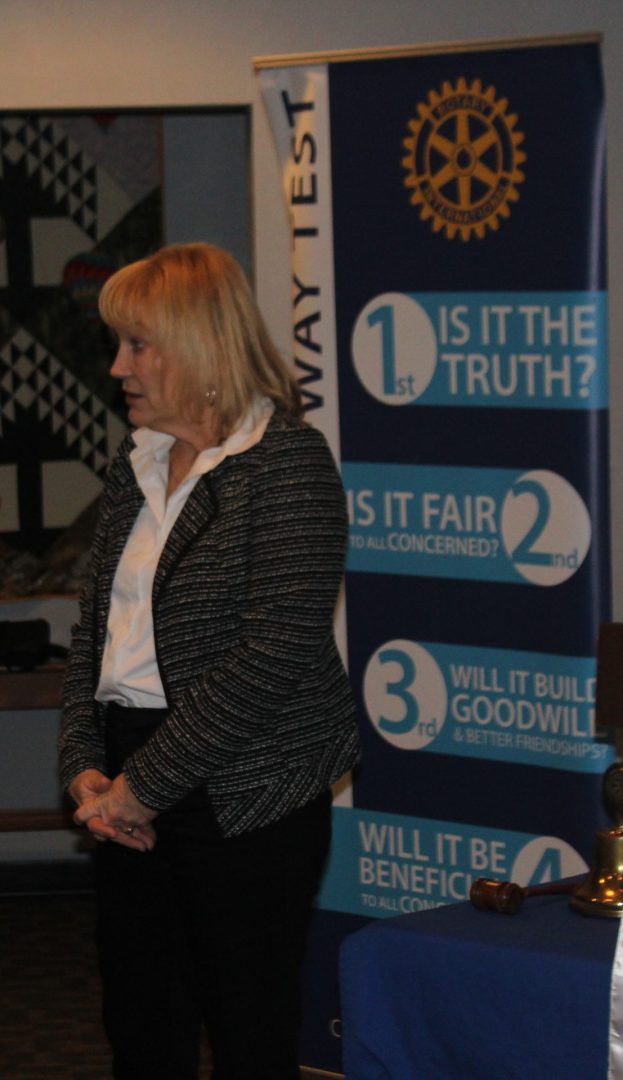
Tina Baker told the Keystone Heights Rotary Club that the community partnership school helps the five percent of students from families that cannot provide their children with what most people would consider necessities. Photo: Dan Hildebran.

BY DAN HILDEBRAN

General manager

KEYSTONE HEIGHTS —The outgoing director of the community partnership school at Keystone Heights Junior-Senior High School said one reason the high school reclaimed its “A” grade this year after 12 years is because of higher graduation rates promoted by her partnership.

Tina Baker told the Keystone Heights Rotary Club that with graduating classes of between 150 and 200, less than five students failing to walk could significantly impact the Orchid Avenue campus’s graduation rate.

“I can stand up here and tell you that last year, there were three students that I know graduated because of the services we provided to those students,” she told the club. “Not only did they attend and pass their tests, but they also walked across that stage— three students. That’s huge.”

The school is a partnership between the school district, the Children’s Home Society, Santa Fe College, and Aza Health Care. It provides students and their families with health, social, and other services.

Last year, high school Principal Laurie Burke told the Clay County School Board that through the partnership, 167 students received tutoring services that resulted in all 167 increasing their grade point averages. She added that five percent of KHHS students received behavioral health services through the partnership school, and over 11% of the student body received medical and dental appointments.

“Thirty-seven students and families were able to use the laundry facility,” she said. “Lastly, 152 volunteers dedicated over 1,300 hours in supporting the community partnership schools initiative.”

Baker told the Rotary Club that the partnership school helps the five percent of students from families that cannot provide their children with what most people would consider necessities.

“And those are the five percent that we will probably be supporting on state welfare, SNAP benefits, housing, and homeless (services),” she said.

Baker stated that one critical service the school offers to change students’ lives is Camp Boost, held at the Montgomery Presbyterian Center for rising seventh graders.

She added that during the camp, the partnership’s mental health counselor establishes relationships with at-risk students and starts substance abuse education with the campers.

Baker said that after the week of camp, where the campers are immersed in substance abuse education, the coaches and P.E. teachers at the high school follow up with consistent content about the risks and dangers of vaping, marijuana, alcohol, and other drugs.

 “We have a great partnership with the coaches at the high school,” she said.  “We push in a foundation that continues in our PE classes. So, one time, you may not get it, but if the kids hear over and over that vaping is not good, and marijuana, even though your parents may be using marijuana because they have a medical need, it’s still not good for you because you have a developing juvenile brain and (marijuana) rewires your brain.”

Baker said that as a Middleburg resident, she thought her hometown had a big heart, but she has been overwhelmed with the community support the Lake Region has shown her students.

“I thought Middleburg was the place,” she told the Rotarians, “but I’m going to tell you right now, people really step up in this community to support our students.”

Baker added that she feels good about leaving the program in the hands of incoming director Isaac Morford and believes the partnership will continue to lift students and the school.