BY CLIFF SMELLEY
The days have been getting pretty hot, but hot enough to bend steel?
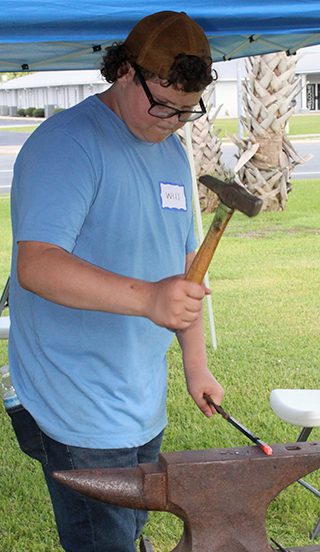
Maybe not, but that’s exactly what some youth found themselves doing as part of the Bradford County 4-H Blacksmith Camp, which was held June 13-14.
The camp was led by Luke Harlow, Bradford’s UF/IFAS Extension agent who works in the area of horticulture/small farms. One of his hobbies is blacksmithing, which he began approximately eight years ago.
“This is the fourth year I’ve provided this for the 4-H program,” said Harlow, who was assisted by his wife, Erin, a UF/IFAS Extension agent in Columbia County, and Jacob Mudge, a commercial blacksmith. “We’re pretty much the only one in the state providing a blacksmith camp.”
Five camp participants made wall hooks and grilling forks out of steel on the camp’s first day.
“I thought they’d make a nice gift for Father’s Day,” Harlow said of the grilling forks.
Participants worked with copper on the second day, making roses — something that Mudge enjoys doing.
At the start of each camp, Harlow likes to ask participants why they wanted to be there. The most-popular answer is to learn how to make knives, which Harlow said is a testament to the popularity of such TV shows as “Forged in Fire” and “Last Blade Standing.”
“That draws in a lot of kids,” he said, “but there are a lot of techniques those bladesmiths had to learn before they even started their first blade.”
Camp participants learned some basic techniques, such as bending, twisting and drawing out, which is making a piece of metal longer and thinner by using a hammer and an anvil.

Then there’s the technique that takes place prior to those other ones — heating up the metal. Camp participants had two coal-fueled forges at their disposal.
Harlow told the youth to remember blacksmithing’s “cardinal rule,” which is, “Assume everything is hot.”
“Safety is our number-one concern,” Harlow said. “I haven’t had anyone burn themselves in four years, but there is always the potential.”
Teaching moments occurred along the way. One participant carried a hot piece of metal to an anvil and then asked, “Where’s my hammer?”
“We’re learning a lesson,” Harlow said. “Make sure you have your tools ready.”
Another lesson? Let the hammer do the work. Harlow said one of the misconceptions about blacksmithing is that it requires brute strength, adding that most people think of “that iconic blacksmith who raises his hammer — usually a big sledgehammer — and just wails on metal.”
“It’s not like that,” Harlow said. “If you did it that way, you’d probably only be able to do this for an hour before you were exhausted.
“I think one of the things they’re already learning (after approximately an hour into the first day) is just how much a hammer does the work rather than the smiths themselves.”
Will any of the participants continue working on blacksmithing skills after the camp? Harlow doesn’t know, but he admitted that’s not his goal. He’d love it if the youth continued exploring blacksmithing, but he wanted to at least impart some knowledge of working with tools and being comfortable using them.
“It may not be blacksmithing, but if they’re working at home on projects, they’ve got some of that confidence to use tools,” Harlow said.
Harlow likes the idea of presenting something new to youth — something they’re not going to learn in school. Unless they have family members who are blacksmiths, they’re not going to learn it at home either.
“Even if this is as far as they go (in blacksmithing), having them have the experience — that makes it fun for me,” Harlow said. “That’s why I continue doing this.”