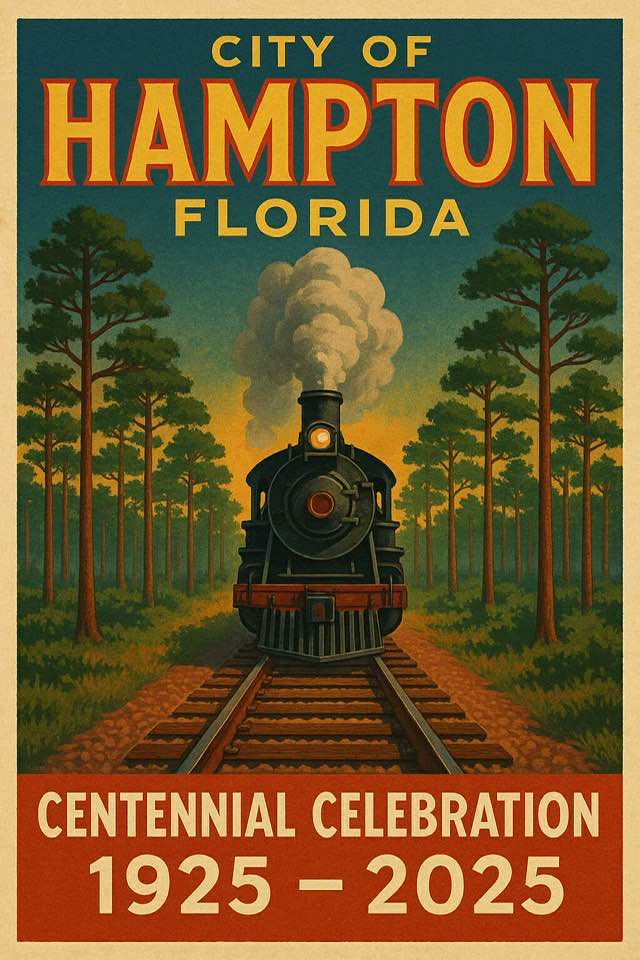
Hampton is hosting a gathering for its citizens and public officials this Saturday, Oct. 25, at Bobbie Sheppard Memorial Park from 11 a.m. to 3 p.m. with music, food and more family fun.
Hampton, Florida — where crossroads became a community, and a little town weathered more than its share of storms, both literal and political.

Long before “Hampton” was on any map, the land around what is now Bradford County was occupied by Native American peoples. The forests, rivers and fertile soil shaped how people lived: hunting, farming and moving with the seasons. New settlers were drawn by the promise of land and opportunity.
The story of Hampton truly begins in 1859, when a settlement sprang up known simply as Crossroads. The name was literal: this was a place where people and rail lines intersected — a junction where the Georgia Southern and Florida Railway and later the Seaboard Air Line Railroad met. Good farmland nearby helped attract settlers. Small stores, homes and farms echoed the rhythm of rural Florida life.
The town grew up around a local farm, and when Blanton and Cameron, town merchants, opened a post office in their store, the name Hampton was officially given to the community in honor of the family whose farm had provided the nucleus of the settlement. Hampton Terry was said to be the name of the farmer’s 10-year-old son.
The 1880s railroad boom gave Hampton an entirely different face. The small settlement flourished with new businesses and industries. At its height, Hampton had a bank, hotel, drug store, lumber mill, several large merchandise stores, a shingle mill, a cotton gin, a turpentine still, and a railroad depot.
Simon Temple, a pioneer lumberman, established a thriving mill just north of town in an area then called Thurston, which even had its own fourth-class post office to serve mill workers. The area no longer exists today, but in its time it helped fuel Hampton’s early prosperity.
As the railroad expanded, so did Hampton, and several churches were established. The first was the Methodist church, located across from the Hampton Cemetery — now also gone. In the late 1800s, two brothers who were also ministers, Rev. G.P. Young and Rev. William B. Young, moved into the Starke and Hampton area. Both were educators and community leaders. W.B. Young opened the Hampton School in 1883 and by 1886 had founded Lake Navarre Academy, named for what was then called Lake Navarie (now Hampton Lake). He also established the First Christian Church in 1884.
Two other brothers, Jack R. and Tom Williams of Alachua, saw Hampton’s dual rail access as a perfect base for their traveling sales business and set up headquarters in town in 1889. They are credited with establishing the Hampton Baptist Church in 1891. Another brother, R.M. Williams, opened the Hampton Hotel that same year — a two-story, 16-room building with accommodations for 25, a large kitchen, dining room and lobby. The hotel became a hub for traveling salesmen who would arrive by train, stay overnight, and then journey by buggy to sell goods throughout the countryside.
The town was incorporated in 1893, though it later allowed its charter to lapse and had to be reincorporated in 1911 and again in 1925. The Big Freeze of the late 1800s devastated the orange groves and crippled the local economy. As timber resources were exhausted and the lumber industry declined, farmers turned to cotton and strawberries. Hampton once had two cotton gins in operation.
The 20th century brought new challenges. As automobiles replaced trains, Hampton was left behind. Road 13 (now U.S. 301) was rerouted in the 1930s to straighten out the hazardous “Hampton Curve,” diverting traffic away from the town. Businesses closed, property values fell, and a series of fires destroyed much of what remained. In 1934, one of those fires consumed the Hampton Hotel. Later that decade, another blaze wiped out an entire block, including the post office and telephone exchange.
Yet, despite it all, Hampton endured.
The town’s later history is as turbulent as its early one. One of the more controversial modern chapters involved its reputation as a “speed trap.” Hampton annexed a stretch of U.S. 301 west of town to issue traffic citations, generating revenue but also drawing criticism from the media and state officials. A 2014 state audit uncovered financial irregularities, prompting resignations and nearly leading to the town’s dissolution. Hampton lost its police department and came perilously close to losing its charter.
Still, the community rallied. New leadership emerged. The city pursued grants to preserve and improve vital infrastructure. Today, City Clerk and Administrator Mary Lou Hildreth, along with council members Mayor Dale Wiseman, Bill Goodge, Douglas Williamson, Dorothy Shealey, Janeece Mullett, and Lillian Sams, lead the city, working to maintain the renewed confidence that more than 100 years later, Hampton still has a future.
Modern Hampton is quiet, rural and largely dependent on nearby communities for services, but it retains its own character — a mix of old homes, newer builds, lakes, and open land.
Hampton’s story tells us a few things:
-That geography — railroads, roads, and climate — has always shaped small towns.
-That agriculture, while promising, is vulnerable to extremes.
-That good governance and community trust are essential.
-And that even when decline seems inevitable, towns like Hampton can rally — preserving history, pride and a sense of place.