BY DAN HILDEBRAN
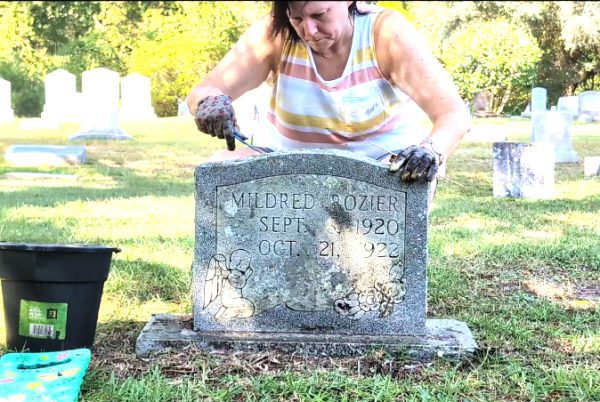
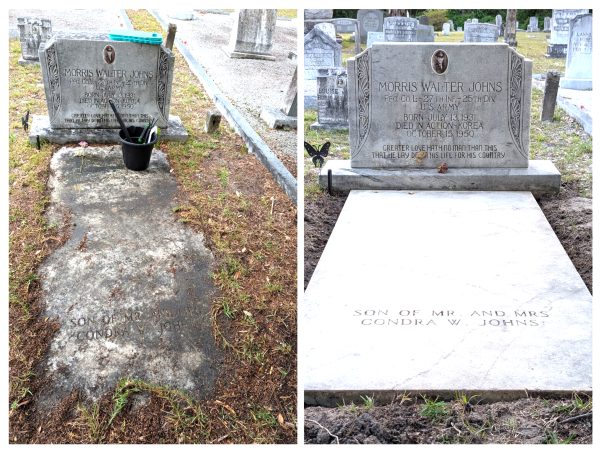
A Raiford woman who has been tending to her parents’ graves for 29 years, this year discovered that honoring those who have gone before is her calling and has cleaned 238 gravestones, 113 of which have belonged to veterans, since April.
Mendy Whitaker said her mother died 29 years ago and her father passed two decades ago. Since that time, she has visited her parents’ graves at Raiford’s Sapp Cemetery at least twice a year, cleaning their graves and replacing flowers.
“I’ve always cleaned my parents’ graves,” she said. “It’s just been dear to my heart, taking care of who took care of me.”
This personal ritual evolved about three years ago when she attended a Memorial Day service in Lake Butler.
Inspired to honor veterans, she began placing flags at their graves in Sapp Cemetery, where she discovered approximately 160 veterans are buried.
Her initiative took a deeper turn after watching a YouTube video by Trae Zipperer from ByMemorialDay.org, which highlighted the neglect of veteran headstones in smaller, private cemeteries compared to those in well-maintained national cemeteries.
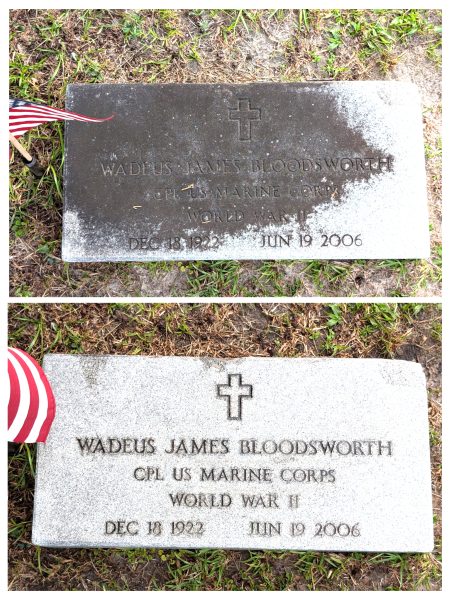
“I started looking at my cemetery, and I’m like, oh yeah, I see what he’s saying. These stones are not being taken care of,” Whitaker recalled.
She added that after cleaning her first headstone, she knew she had found her calling.
“I was searching for what God was calling me to do,” she said. “When I cleaned that first headstone, I knew that this was what He wanted me to do. Not for selfish reasons but as a way to give back to my community. Cleaning these headstones is a joy and honor for me.”
‘Her veterans’
Whitaker added that when she cleans gravestones, she is making their memories visible again and honoring the lives they lived.
“Some of the stones cannot be read, so when they are cleaned, you can see ‘them’ again,” she explained. “You can say their name, and for that brief moment, they are remembered. Families of these people move away or pass away, and the deceased stay and need tending.”
Whitaker refers to the veterans she tends to as “her veterans.”
“My veterans have a special place in my heart,” she said. “They made the decision, whether they saw combat or not, to give up their life and freedom to serve this great country to ensure we stay free, and for that they deserve honor and respect, and the very least I can do is to clean their headstones and place a flag at their gravesites.”
The Raiford woman’s work has concentrated at Sapp Cemetery, but she has also rehabilitated stones at Douglass and Dekle cemeteries in Lake Butler, Elzy Chapel in Worthington Springs, South Prong in Sanderson, Crosby Lake and Dyal Cemeteries in Starke, and Ben Smith and the Beams Cemeteries in Kentucky.
She added that she doesn’t touch a gravestone without the permission of either the cemetery or the deceased’s family.
She also said she strictly follows cleaning guidelines issued by the Veterans Administration’s National Cemetery Administration, which prohibits pressure washing and prescribes a D2 biological solution and Magnolia or Tampico brushes.
The lack of water sources at cemeteries posed a challenge until a friend gifted her a five-gallon battery-operated water sprayer, prompting her to purchase a second one.
She estimates a gallon of D2 Biological Solution, costing about $50, can clean 30 to 50 headstones, depending on their size.
While some individuals have offered donations to support her efforts, Whitaker emphasized that her work is not driven by financial gain. “It’s just a passion for me now,” she said, noting that while some people clean headstones as a business, her motivation is to give back to the community and honor the memory of others.
Saying ‘Thank you’
Whitaker credited her husband, Rick, and her girls, Jordan and Taylor, for supporting her efforts.
She has been documenting her work on her Facebook account, Mendy Wilson Whitaker.
She said while she acknowledges that her calling isn’t for everyone, she hopes others will follow her lead in remembering and honoring veterans and loved ones, a practice she recalled from her childhood.
“My aunt and I remembered growing up,” she recalled. “Once a year, everybody would go out to the cemetery. You’d have one day, and you’d have family upon family upon family, just out there cleaning.”
“It’s everybody’s personal choice, what they do,” she added. “But I like the idea of being able to go and say thank you to my parents for what they did for me. And now, when I clean others, these are somebody’s parents, these are somebody’s kids. It’s something I can do; it’s a way for me to give back to people.”