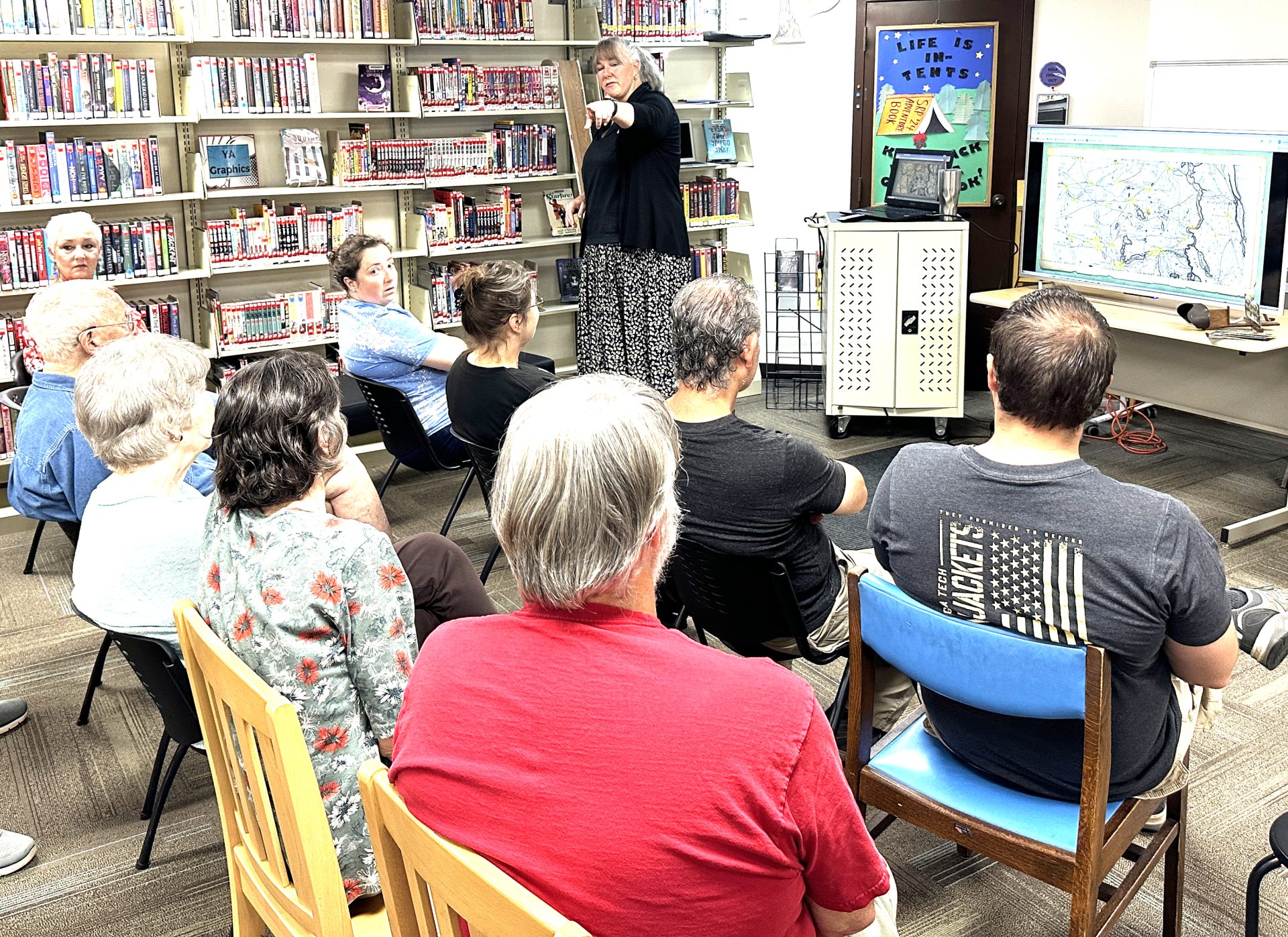
Keystone’s early years reviewed

Christine Arnold covered the city’s history from the 1830s until the 1929 stock market crash, which marked the end of the town’s initial growth.

BY DAN HILDEBRAN

[email protected]

The Keystone Heights Heritage Commission chair lectured at the Keystone Heights library about the city’s early years.

Christine Arnold covered the city’s history from the 1830s until the 1929 stock market crash, which marked the end of the town’s initial growth.

The number 11 figures in the town’s early history, and even in recent years, with the naming of the county’s local fire station:  Station 11.

Arnold said that number was derived from a map of Florida drafted by Zachary Taylor during the Second Seminole War in which the U.S. Army commander drafted a grid through the state, and the Lake Region was located within Square 11. A fort built near the current city hall was named Fort 11, and Lake Geneva was designated as Lake 11. 

Although the war produced no local conflicts, soldiers in the fort were assigned to patrols to keep the roads safe.

Arnold said the conditions at Fort 11 were better than most other Florida forts because of its access to clean water.

The Heritage Commission chair said the first railroad came through the area in 1803. The station was based in Newberg, near the current Circle K at State Road 100 and County Road 214, also known as the Gizmo. An additional community called Brooklyn was near the current site of Hitchcock’s Grocery.

Arnold said almost all travel was done by railroad because the conditions of the roads were horrible, and Florida was a free-range state. Cattle often sat in the middle of dirt grades, making passage difficult.

“In 1923, a trip from Green Cove Springs to Keystone took four hours, and to Gainesville took an entire day if you went by road,” she said.  “In 1924, eight trains a day on the Georgia Southern and Florida Railroad came by, four passenger (trains) from Valdosta to Palatka and four freight.

Arnold said a Mr King built a hotel in Brooklyn, which coincides with the name of King Street, a dirt road that runs north from State Road 100 past a county boat ramp on Lake Brooklyn.

The Brooklyn community was established in 1905. Mr. Lee persuaded the railroad to move the depot to Lake Geneva, and afterward, Lee constructed the Lake Geneva Hotel nearby.

In 1917 a Mr. Zell bought a large portion of land in the area. Zell had worked with John Lawrence in Sebring.

“He was established in Sebring, but there was something, and I don’t know what it was,” Arnold said of Lawrence. “He became disenchanted with Sebring after building a house and everything.”

Zell brought Lawrence to the Lake Region for a visit, and the Lawrence Boulevard namesake fell in love with the area.  

At the time, the community of Brooklyn was still functioning near the current Hitchcock’s. However, when Lawrence arrived, he moved the focus of development to the shores of Lake Geneva.

Arnold then cataloged some of the town’s earliest settlers and the homes they built, many of which are still occupied.

One newcomer was Donald Pangborn, who founded the Keystone Lumber Company with his partner Ed Caughey.  That business continued to thrive until it was bought out by Jackson Building Supply, which later sold the land to Walgreens.

Pangborn was the local supplier of lumber for Sears home kits. The Lawrence bungalow at the corner of South Lawrence Boulevard and Southwest Jasmine Avenue was a Sears kit home, but its lumber was shipped by rail from Pittsburg because the Keystone Lumber Company had not yet been established. Arnold said John Lawrence’s familiarity with the home-building concept made it a popular option in Keystone Heights.

Arnold said customers would choose a floor plan, and the factory, later Keystone Lumber, would cut the wood and number the pieces for assembly.  Arnold showed the crowd at the library some planks from her house with the Sears kit numbering on them.

Eventually, Lawrence sold his interest in the development company to Frank Miller, a Pennsylvania State Senator from Meadville. Miller brought Ed Larson to the area, and Larson would eventually become Florida’s comptroller.

Arnold also reviewed some early photographs of the town, which featured landmarks such as the city’s first gasoline station, Babbit Drugs, and Watson’s Grocery.

Arnold said the stock market crash of 1929 and the following depression took the wind out of the Lake Region’s development in the first quarter of the 20th century.  However, growth would rev up again with World War II’s onset and Camp Blanding’s establishment less than 20 years later.