Lake Region in severe drought

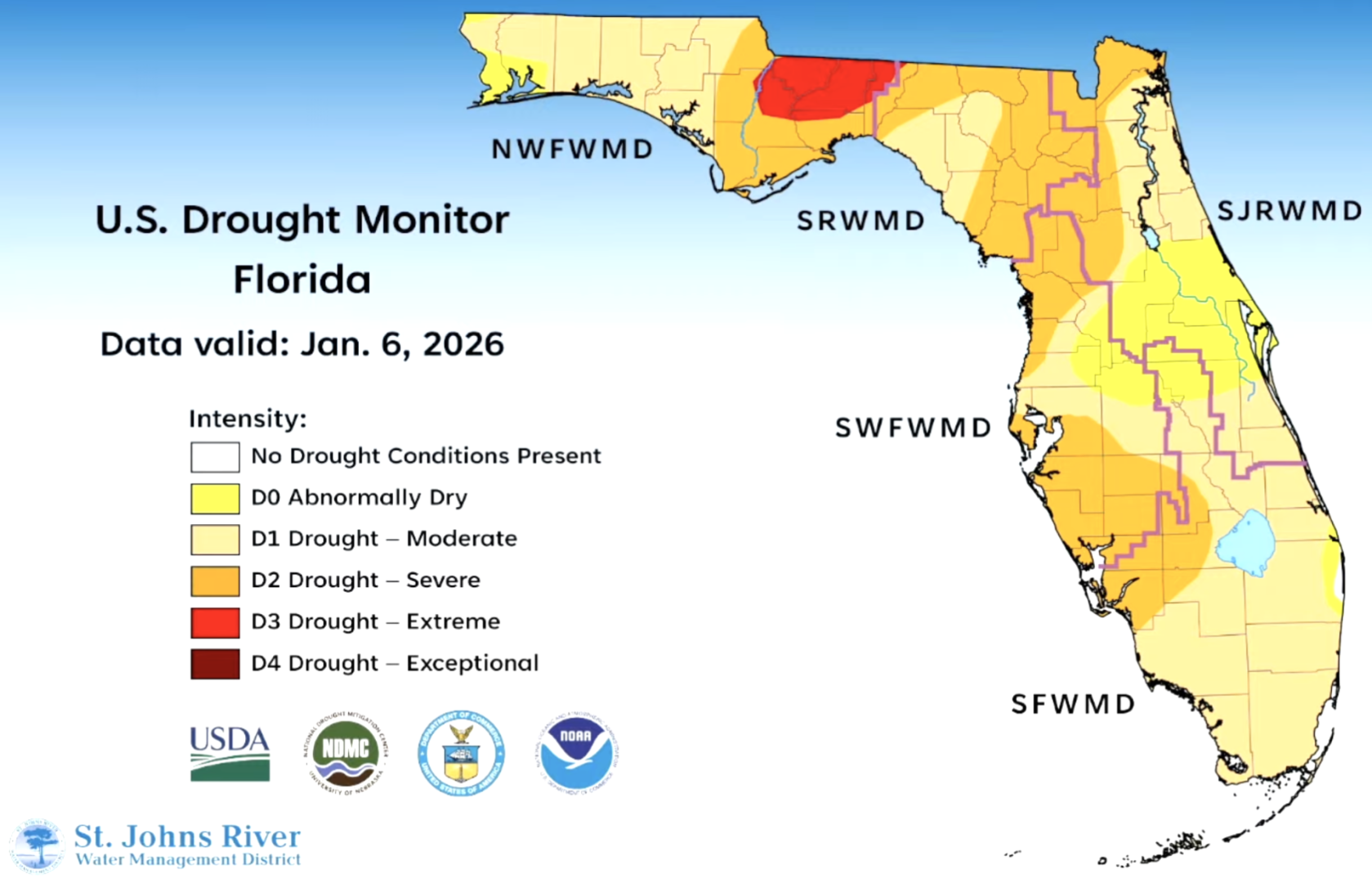
The U.S. Drought Monitor showed abnormally dry conditions in Volusia, Lake, and Orange counties, moderate drought conditions in Duval, St. Johns, Flagler and eastern Clay, Putnam and Marion counties, and severe drought in western Clay, Putnam, and Marion counties as well as all of Bradford, Union, Nassau, Baker, Columbia, Alachua, Gilchrist and Levy counties.

[email protected]

The bureau chief for the St. Johns River Water Management District said below-average rainfall in December pushed the western and northern sections of the district into severe drought conditions, with other areas of the 18-county district undergoing moderate drought conditions.

Tim Miller briefed the district’s governing board during its January 13 meeting and said the district averaged just 0.91 inches of rainfall in December, falling short of the monthly average of 2.54 inches.

The shortfall extends a concerning pattern, with annual rainfall totals now more than five inches below the normal average of 51.01 inches.


Widespread below-normal conditions

Seventeen of the district’s 18 counties recorded below-normal precipitation in December, with eight counties receiving more than an inch less than their monthly averages. Okeechobee County experienced the driest conditions with only 0.54 inches of rainfall, while Orange County topped the region with three inches.

The deficit has been particularly severe in northern and western areas. Bradford County recorded the lowest annual total at just 37.35 inches, while five counties including Baker, Bradford, Alachua, Marion, and Putnam fell more than 11 inches below their annual averages.


Entire district under drought classification

The latest U.S. Drought Monitor assessment classifies the entire district as experiencing some level of drought, ranging from abnormally dry conditions in central portions to moderate and severe drought in western and northern areas.

The Keetch-Byram Drought Index, which measures wildfire potential, shows concerning upward trends with five counties now recording values of 500 or higher. County-enacted burn bans are currently in place for Baker and Bradford counties, with several other counties under burn ban restrictions.


Water levels declining across region

Surface flows and water levels reflect the dry conditions. The St. Mary’s River to the north recorded flows in the very low range, while the Alafia River to the west registered low flows. Most lake levels decreased through December, with Lake Brooklyn dropping nine-tenths of a foot from the previous month.

Groundwater conditions show a mixed picture, with approximately 70 percent of monitoring sites recording decreases in the Upper Floridan Aquifer. Areas of low groundwater levels have expanded in St. Johns, Putnam, Alachua, and Marion counties, while very low levels persist in Duval County. The district-wide aquifer index value dropped 32 points from the previous month, though it remains in the normal range.

Spring flows also reflect the dry conditions. Silver Springs saw an 18 cubic feet per second decrease from the previous monthly mean and remains in the low range for this time of year.


Conservation urged as forecast remains dry

Weather forecasts provide little relief, as La Niña conditions persist and the National Weather Service predicts a cooler, drier winter. The NOAA Climate Prediction Center indicates a greater likelihood of less-than-normal rainfall and higher-than-normal temperatures in coming months, though with some uncertainty.

Miller emphasized the importance of water conservation by residents as the district moves through the traditionally drier winter and spring months. While typical evapotranspiration rates are lowest in December and cooler conditions help reduce water loss, the cumulative rainfall deficit and dry forecast raise concerns.