Opioid settlement funds Naloxone, fall prevention, chronic disease treatment

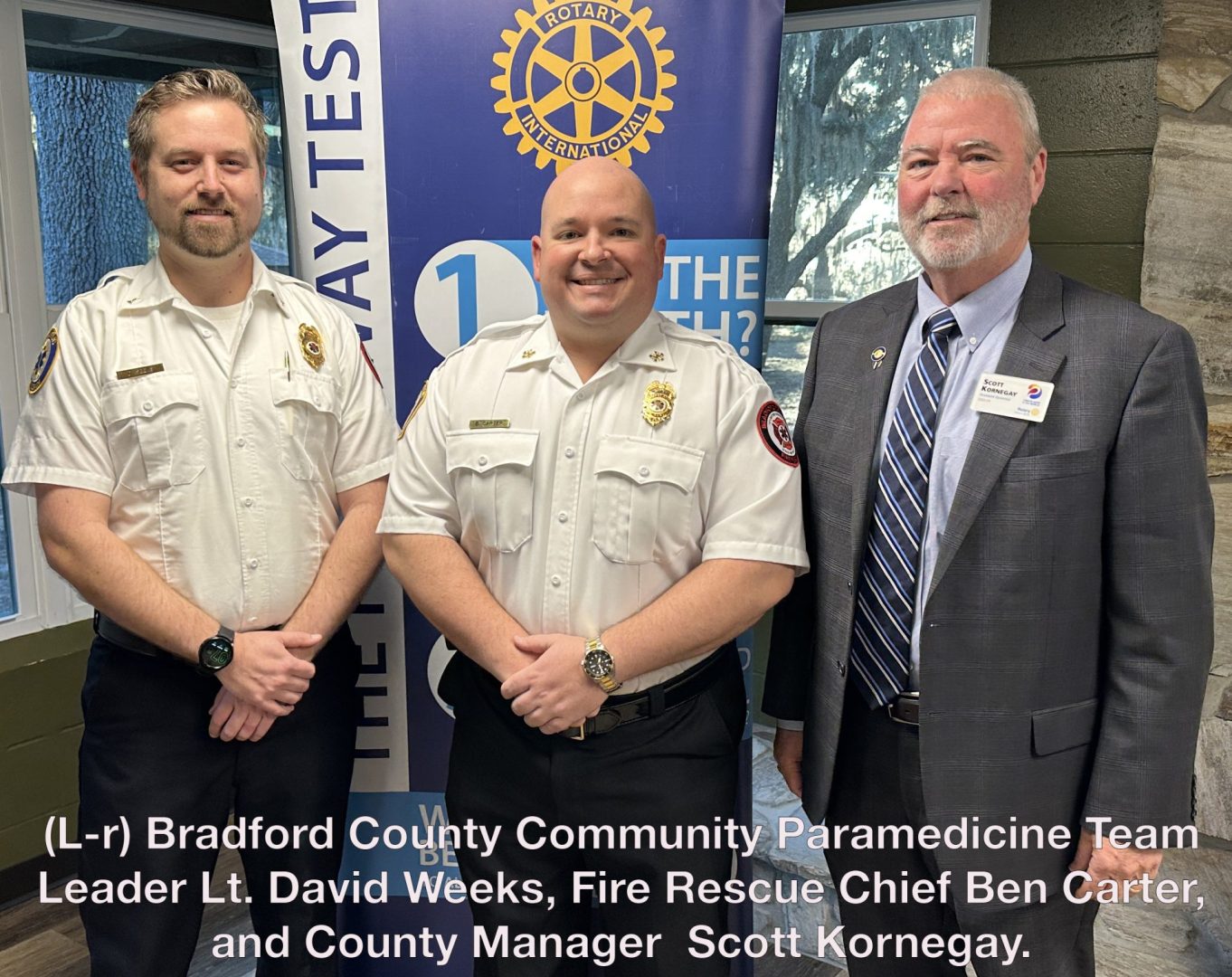
(L-r) Bradford County Community Paramedicine Team Leader Lt. David Weeks, Fire Rescue Chief Ben Carter, and County Manager Scott Kornegay.

BY DAN HILDEBRAN

[email protected]

 The Bradford County Fire Rescue lieutenant leading the county’s community paramedicine effort gave the Keystone Heights Rotary Club an overview of the program on Wednesday, January 29.

Lt. David Weeks leads the team, and University of Florida interns Elijah Hendley and Casandra Ramirez joined the program as support specialists two weeks ago.

Fire Chief Ben Carter told the civic group that the county’s paramedicine program has been running for about one year, is funded through opioid settlement money, and does not cost local taxpayers.

Carter added that he had asked the board of county commissioners for two years to ensure the program had a significant impact.

“If it’s not a staple in our community within those first two years,” he told the Rotarians, “then let’s do away with the program.”

The chief added that, in his view, Weeks accomplished that mission in only eight months.

Frequent flyers

“It really has turned into something more than anything we thought it could be,” Carter said. “The goal of it originally was for opioid abatement, and so our repeat offenders, drug users, and things of that nature are who we targeted originally.”

Carter said one goal of the program is to shift heavy users of the county’s emergency medical services and local hospital emergency departments to more appropriate and effective care. He called those individuals frequent flyers.

“Some of our frequent flyers were using the emergency departments as their primary care, and it was crowding up the emergency departments,” he said.  

“I’ll give you an example,” he told the Rotarians.  “We had one patient we transported 52 times last year. That’s once a week. And so, we essentially just spent a lot of resources taking care of that one patient. I don’t have the numbers in front of me, but I think it was something around in the neighborhood of $150,000 that was just on that one patient, essentially between the transports and whatnot.”

Carter claimed that through the paramedicine program, that patient no longer requires frequent trips to the emergency department.

“We’ve not transported that patient in quite some time due to the efforts of Lieutenant Weeks,” he said.

Whatever it takes

Weeks told the group that of the 148 calls for service his program has responded to, 43 resulted from referrals from fire rescue crews. He added that his program had distributed 220 boxes of Naloxone, the nasal spray that rapidly reverses opioid overdoses.

“Whenever they complete a patient report,” Weeks said of ambulance crew members, “they have the ability to flag that patient for further follow-up with us. Maybe they’ve identified that (the patient) needs help with transportation, they have a substance abuse problem, they may have trouble with their insurance, anything like that.”

Weeks said the first step is a face-to-face meeting with the patient, whether at home, the hospital, or anywhere else.

“We’ll meet ’em on the side of the road,” he said. “Whatever it takes. We always try to go to that patient. And from there, once we’ve identified their initial needs, we’ll start to work with that patient. We’ll start referring them to any organizations that could help them, whether it’s utility assistance, like I said, transportation needs, things like that.”

Four areas of focus

Weeks said his program focuses on four areas: substance abuse, fall prevention, chronic disease, and accessibility.

The substance abuse segment features the opioid abatement measures of free naloxone kits, naloxone cabinets, and public education.

Weeks added that his program had distributed 220 boxes of Naloxone, the nasal spray that rapidly reverses opioid overdoses and is also known under the brand name Narcan.  

Weeks said that in addition to distributing Naloxone, he has established a partnership with Meridian Healthcare to help in the substance abuse focus of the program.

The lieutenant added that his team will start teaching fall prevention courses at the county’s senior center soon.

“Fall prevention is another one of the projects that the two interns are going to start working on,” he said, adding that the pair will become certified through the state in the course “A Matter of Balance.”

He added that Fire Rescue already has a list of residents who have fallen repeatedly. He said his team would approach those people, asking them to enroll in the eight-hour “A Matter of Balance” course.

He also said his team will perform in-home assessments.

“We’ll first find out why they are falling so much,” he said. “Is it a squeaky wheel on their walker, or maybe they’re getting dizzy?”

Weeks said Fire Rescue responded to four fall calls from one person within a week.

“So, finally, we were like, all right, let’s go talk to this guy, see what’s going on,” he recalled. “Come to find out, one of the wheels on his walker was deflated, and that was causing him to fall. So, we inflated that wheel and haven’t been to him since. It’s just little things like that that nobody’s really taken the time to address. By doing that, we’re able to help these people and ultimately reduce the number of calls that we’re receiving.”

Weeks said managing chronic disease is emerging as the most significant part of the community paramedicine program.

“Say you have a patient with real bad diabetes,” he said. “They might not be compliant with their medications. We’ll go in their home, we’ll go over their diet with them. We’ll make sure that they’re taking the medications that they should, and then we will create a care plan for them.”

Weeks added that his team would follow up with weekly visits to ensure the patient followed the care plan.

The community paramedicine program has also taken on what Weeks and Carter characterized as large projects, such as building ramps or decks for patients with accessibility needs.

He said Fire Rescue responded to one patient 12 times in one month, and all the patient needed was help getting from his front door to his car for doctors’ appointments.

“So, what we did was we partnered with local church groups…and we were able to get this very nice, large ramp built free of cost to the patient,” he said, “and I’m happy to report since then, we’ve been out there twice, and it’s been for actual medical emergencies. We haven’t had to send any crews out there for any lift assist or anything like that.”

People care, not just patient care

Weeks ended his presentation with his team’s outlook, inspired by Dr. Pete Gianas, whom Weeks said hired him 12 years ago.

“Something that he always said, and it’s always stuck with me and the rest of our guys,” Weeks recalled. “People care, not just patient care. The people that we’re taking care of, yes, are patients, but they have a life and a family. Treat them as if they’re one of your own. That’s really stuck with us, and that’s kind of how we run this program.”