BY CLIFF SMELLEY
Science, technology, engineering and math.
STEM education is a focus in schools and also a part of some students’ summers through activity filled camps that challenge the mind, but are also fun.
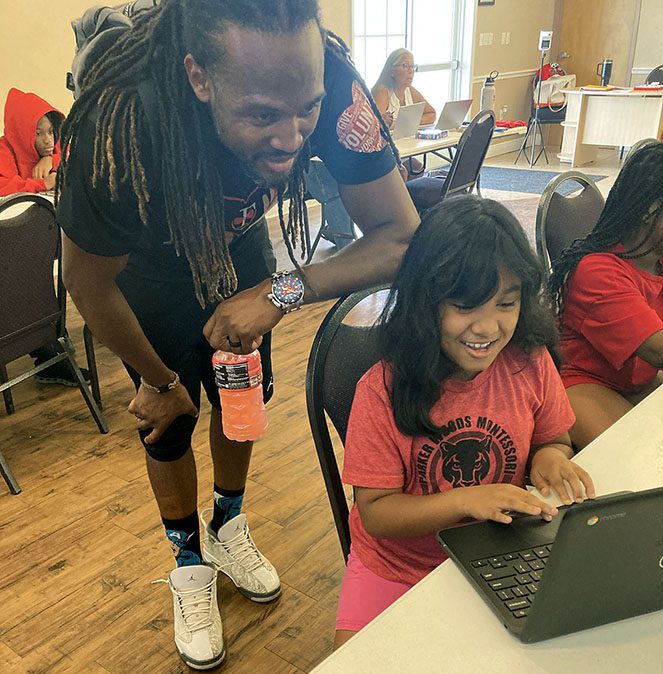
The annual I AM STEM camp offered in Starke by Edrick Hamilton and his 12G mentoring program, however, is about so much more that science, technology, engineering and math. It’s about life.
Sure, the children are doing things like building rockets and even using math skills in a tasty way by making sweet potato pie in the camp, which began June 17 and runs through July 2, but they’re also learning about various aspects of health and safety and how to communicate and cooperate with others.
Hamilton said the children, who are entering second-eighth grades, participated in an activity in which they stood in a circle and passed items to the person to the right or left of them. The children, who were wearing name tags, had to say their name and then the name of who they were passing the object to. After having done that a couple of times, then the order was changed, forcing them to pass the objects to different people and learn different names. Hamilton said the goal was for the children to talk to each other. If they didn’t how to pronounce a name, they could ask. If they heard a mispronunciation of their name, they could correct it.
Communication was key in another activity: People, Tigers, Traps. It was like Rock, Paper, Scissors, with the children using body movements and positions to act out whether they were a person, a tiger or a trap. A person beats a trap, a trap beats a tiger and a tiger beats a person.
At first, the students were divided into pairs, competing one on one. The two competitors would then be paired together on a team to play against another twosome. Larger and larger groups kept being created. It required the children to talk to each other and decided which they were going to be: a person, a tiger or a trap.

Learning how to work together, which could be a big benefit to those children when they become adults and find themselves having to do the same in a job.
Hamilton hopes the activity will also help the children focus on what they need to in their school classrooms. For example, if a team is discussing whether or not to act out the role of a person, tiger or trap, and one person isn’t paying attention, it’ll show when that one person does something different.
“If you’re in a classroom, you’ve got to make sure you get rid of those distractions,” Hamilton said.
As has been the case in the past, the camp, which takes place at the Church of God by Faith Community Center, will include visits from personnel in such organizations as Bradford Fire Rescue and UF Health, who will teach the children such skills as applying bandages and tourniquets and performing CPR.
Hamilton has said in the past that it may seem like some of the camp participants are too young to try to learn CPR, for example, but one never really knows what will lodge itself in a child’s mind, remaining there until it’s needed in the future.
“We don’t know what the kids are going to retain,” Hamilton said, “but if you give them that, that’s a seed you’re sowing. They may not be large enough or strong enough to provide a service for an adult, but if they learn it, they can teach it to an adult next to them who doesn’t know how to do it and could help save a life just by having that knowledge.”
In fact, Hamilton would like to have health-related and emergency services personnel be part of a larger event for the public, knowing that the more knowledge more people have, the greater number of people can be helped when an emergency situation arises.
“That’s the goal for next year, to have it as a community event,” Hamilton said.
The STEM camp also includes visits from Meridian Behavioral Healthcare personnel, who talk to children about emotions and cover such topics as bullying and respect.

A STEM camp wouldn’t be a STEM camp, though, if it didn’t include the hands-on activities that, hopefully, make learning STEM principles fun.
Not every child, of course, is going to experience first-time success with whatever project they’re working on at the time. That’s OK. Hamilton said the key is to get the children to think through the project and determine how they can fix whatever’s wrong.
“If you just shut down and give up, you’re not learning anything,” Hamilton said, adding, “When I see them all engaged, and they’re trying things, that’s all I care about. They’re learning (when they do that).”
Each day begins with a chant, which reminds the children that they are doing more than participating in a summer camp. They are striving to be successful in life.
I…Innovators. Pushing forward to be creators.
A…Achievers. Being all that we can be.
M…Motivated. To fulfill our purpose and destiny.
I AM STEM. Science and technology.
I AM STEM. Engineering and math, these are for me.
I AM STEM. That’s my identity.
I AM STEM. That’s what I will be.