BY CLIFF SMELLEY
Bradford County students who are considered food insecure have food to eat over the weekends during the school year, thanks to the Food4Kids Backpack Program of North Florida.
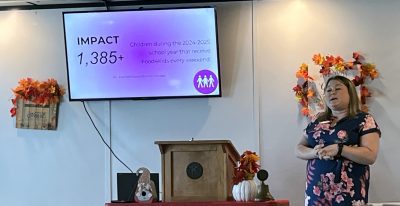
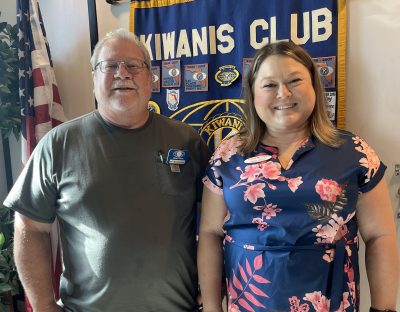
Executive Director Margot DeConna spoke to the Kiwanis Club of Starke on Nov. 18 about her organization, which provides food to 165 children in six Bradford schools. The backpack program serves 68 schools overall in Bradford, Alachua, Dixie and Levy counties.
“Basically, what we do is we provide bags of non-perishable food — non-perishable meals and snacks — every single weekend during the school year,” DeConna said. “We pack centrally for Alachua County out of our warehouse in Gainesville, but in Bradford County, we actually provide all of the inventory, and then Bradford County residents pack those bags and deliver those bags to the schools directly.”
When students are away from school for longer than a weekend — Thanksgiving, Christmas, spring break — their families are provided with 30- to 40-pound boxes of food.
“It is all the food they need for all those other meals they’ll be missing if they rely on free breakfast and lunch at school,” DeConna said. “It’s things like spaghetti and sauce. It’s things like canned soup, canned pasta, ramen, canned meat, cereal, shelf-stable milk, snacks, saltine crackers and peanut butter and jelly.”
DeConna said she works closely with Blake Dicks, director of food and nutrition services for the Bradford County School District, Iana Patterson of the Florida Department of Health in Bradford County, and Candace Osteen, who serves as the backpack program’s local enrollment coordinator.
Shocking revelation
The program got its start when Jennifer Moore took pizza, cupcakes and juice to a third-grade classroom at Gainesville’s Terwilliger Elementary School on a Monday in 2010 to celebrate her daughter’s birthday.
“She noticed that some of the kids in the class were taking second and third slices of pizza before others had finished their first,” DeConna said.
When Moore asked the teacher about it, she was told that those children probably hadn’t eaten anything since lunch at the school on Friday.
“She was shocked — shocked to learn there were so many children in our community who went all weekend without access to food for any number of reasons,” DeConna said. “She was called to act.”
Food insecurity
DeConna told the Kiwanis Club members that food insecurity is defined by the U.S. Department of Agriculture as “lack of access to adequate nutrition for a healthy life.”
Based on statistics recorded in Feeding America’s Map the Meal Gap study, 18.4 percent of children (ages 0-18) in Florida in 2023 were food insecure. That equates to 806,870 children. DeConna said that was a 2.7-percent increase from 2020 numbers.
In Bradford County, 1,440 (25.3 percent) children were considered food insecure in 2023.
“Obviously, having a lack of adequate access to food as a child can have lifelong effects,” DeConna said, explaining that hunger can make it harder for children to perform in school, prevent them from growing and developing as they should, and lead to increased illness and high health costs.
DeConna said Food4Kids is helping eliminate one choice families in financial straits are having to consider.
“More than anything, I think what Food4Kids does is we help families sort of relieve the burden of having to make a decision on whether they’re going to pay their electric bill, or they’re going to pay their rent or they’re going to get their car repaired so they can then get to work, or feed their children,” she said. “A lot of times, food-insecure families are having to make tradeoffs between paying bills and buying food. We see that’s especially true right now across the country.”
Identifying and meeting the need
Food4Kids works with the schools to determine the children who would be candidates for the backpack program. Each school has someone who acts as a liaison, who accepts referral reforms from anyone on campus who sees a child who may benefit from the program. DeConna said “anyone from the principal to the lunch lady” can recommend children for the program.
The liaison sends a consent form home with the student, notifying parents or caregivers of the program and, if they agree to participate, having them answer such questions as how many total children are in the home, does anyone in the home have food allergies, and does the home have a can opener.
When the liaison gets the forms back from the families who choose to participate, they are passed on to Osteen.
“Candace manages all of those enrollments,” DeConna said.
Food bags/boxes are delivered to Starke on Thursdays. Children receive the food on Fridays.
DeConna said older children receive their food in duffel bags or rolling backpacks “because we know they’re less likely to take the food home if their classmates know they have this need.”
There are a lot of stigmas around that,” DeConna said. “We do everything we can to try to reduce that stigma and get kids to take the food home when they need it.”
A five-week rotation is employed with the food bags, DeConna said, meaning that children aren’t receiving the same types of food every week.
“If they got cereal and shelf-stable milk this week, next week they’ll be getting brown-sugar oatmeal,” DeConna said
Supporting the effort
People can help in numerous ways, including volunteering in some capacity, donating food or collecting food.
“We are looking for businesses and offices and big organizations and civic organizations who’d be willing to host food drives here for the Food4Kids Backpack Program,” DeConna said.
Another way of assisting is by sponsoring a child. For $9 per week, you can feed a child for a year.
The money goes a long way because Food4Kids purchases food in bulk.
“I like to give a real-life example of what that looks like,” DeConna said. “My kids love Crispix cereal. I grew up eating it as a snack. Now, they love it for breakfast or as a snack straight from the box.
“If I go to Publix and purchase Crispix creal, it’s $7.99 a box. It’s not even like it’s sugary. It’s not like Fruit Loops or anything. It’s crispy corn and rice, right?
“If I buy two boxes of Crispix, I’d be spending $16 a month. If I gave that same $16 to Food4Kids’ Backpack Program, we could turn that into 10 boxes of cereal because we purchase in bulk. We’re feeding 10 families with that same amount of money as going to the store and buying two boxes of cereal.”
If you’d like to help in some way or find out more information, you may visit www.food4kidsfl.org or the Food4KidsBackpack page on Facebook (www.facebook.com/Food4KidsBackpack). You may also call 352-888-6645 or send email to