Starke Kiwanians learn about BC’s new beekeepers club

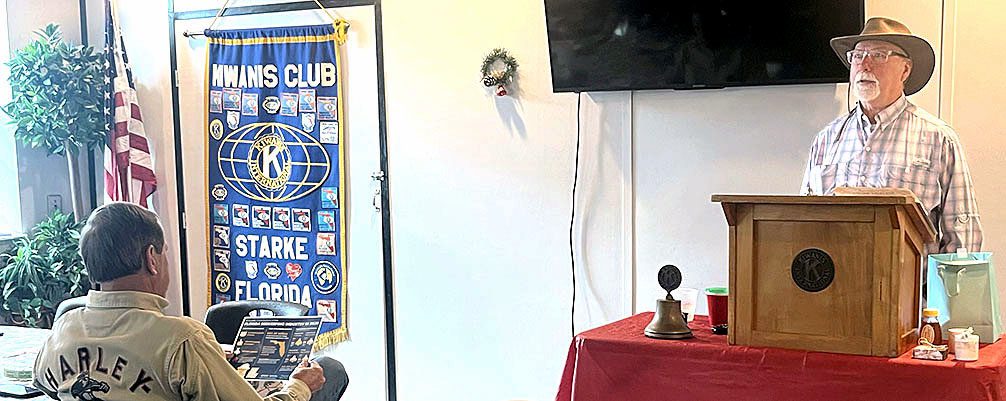
Bobby Carter (right) speaks to the Kiwanis Club of Starke about the Bradford County Beekeepers Association, which meets monthly and welcomes anyone to join, even if they don’t keep bees.

BY CLIFF SMELLEY

[email protected]

As Kiwanis Club of Starke members were eating lunch at their meeting on Dec. 9, they were reminded to be thankful for the work of bees.

Guest speaker Bobby Carter presented a program on the Bradford County Beekeepers Association, which was formalized on Aug. 26.

“When we think of bees, they sting you, and they’re the bad guys, but they’re really good,” Carter said. “One in every three mouthfuls you eat today had to do with a bee. Bees are very important to us.”

Carter is one of 19 registered beekeepers in Bradford. He had been paying for pollination services to bring bees to his farm, but decided it’d be more economical to keep his own bees.

“We’ve had bees for about three years now,” he said, adding, “I got bees, but I didn’t know anything about bees.”

The idea for having a local beekeepers association sprung from discussions Carter had with several others.

 “On May 1, 2025, we had an interest meeting,” Carter said. “About 20 people were in attendance.”

Carter said two more meetings were held, with the second resulting in the official formation of the Bradford County Beekeepers Association. Meetings are held the fourth Tuesday of every month at the UF/IFAS Extension Bradford County office at 6:30 p.m.

“We’re looking for new members,” Carter said. “I think we’re around 22 to 25 members right now. Our arms are open. We want as many as we can.”

That includes anybody.

“You don’t have to have bees to be a member of the club,” Carter said. “We welcome anybody. In fact, if you have an inkling of an idea that you’re interested in bees, I recommend you join the bee club. You’ll get lost of information.”

Membership is $20 per year.

The Bradford County Beekeepers Association can be found on Facebook and at bradfordbeekeepers.com.

The club’s focus right now is providing information to beekeepers and those who may want to be beekeepers, but Carter said it may evolve into more of a civic group like Kiwanis in which it participates in community events and perhaps partners with Kiwanis or other groups.

“We’ll see,” Carter said. “If you all have got something you think would benefit us and benefit you, reach out to us.”

Beekeepers are required by law to be registered, Carter said, adding, “Florida has the toughest beekeeping laws in the country and the toughest honey regulations in the country. The other 49 states are considering adopting Florida’s laws.”

A Kiwanis member asked Carter if most of the Bradford County Beekeepers Association members sold honey. Carter said no and that he himself is only in his first year of selling honey. He planted a couple of acres of clover, saying the most sought-after honey is clover honey.

“The one good thing about the clover is there’s no need to spray pesticide on it,” Carter said.

Carter said people think honey is where the money is in beekeeping, but he said the better money maker is selling established hives and queen bees.

“You get $25 to $50 per queen,” he said. “If you can raise $300 or $400 a week, you can be rolling in money. Santa Fe Farms out in Alachua — they probably do $1,000 a week.”

Besides selling honey, Carter said he has also begun selling honey infused lotion. Using the lotion himself has helped him with a skin condition.

“I have rosacea on my face. I have a prescription I started buying and putting on it. It didn’t do anything for it. I started using this,” Carter said, holding up a container of his honey lotion. “It’s clearing it up.

“Honey has a natural antibiotic in it. I think that has a lot to do with it.”

Kiwanis members had the opportunity to try the lotion as Carter continued to talk about bees. He said the University of Florida has a “great bee lab” and that the lab will be setting up pollen collectors on his farm to determine what flowers and trees his bees are actually visiting.

“The lab also has a tracker. It’s hard to believe that,” Carter said. “They have a tracker they put on the bee. The bee goes out and comes back in. (The tracker) identifies every site he went to — every tree or bush that he went to.”

If you’d like to find out more about the UF Honey Bee Research and Extension Lab, visit entnemdept.ufl.edu/honey-bee. The lab, located at 1881 Natural Area Drive, Building 964, in Gainesville, hosts public tours the first Wednesday of each month at 3:45 p.m.

Carter provided Kiwanis members several handouts with information compiled by UF and its Institute of Food and Agricultural Sciences. One listed “interesting facts about bees,” such as one third of the plants eaten by humans are dependent to some extent on bee pollination; a worker bee can visit as many as 5,000 flowers per day; the number of beekeepers in Florida rose from approximately 600 in 2006 to more than 5,000 in 2019; a bee will produce one eighth of a teaspoon of honey in its lifetime; and the number of beekeepers in Florida rose from approximately 600 in 2006 to more than 5,000 in 2019.

One of the handouts listed the economic contributions of the Florida beekeeping industry in 2020. Florida beekeepers produced more than 15 million pounds of honey, 300,000 pounds of beeswax, more than 350,000 queens and 300,000 colonies (used for crop pollination within and outside of Florida). Florida beekeeping operations produced $93.36 million in sales revenues in 2020, with $51.63 million coming from goods produced and services provided in Florida and $42.01 million from goods and services provided in other states.