A student-run credit union branch took six years to land at Bradford High. The man who built it says the lesson that sticks isn’t the one about money.
BY DAN HILDEBRAN
Dan@BcTelegraph.com
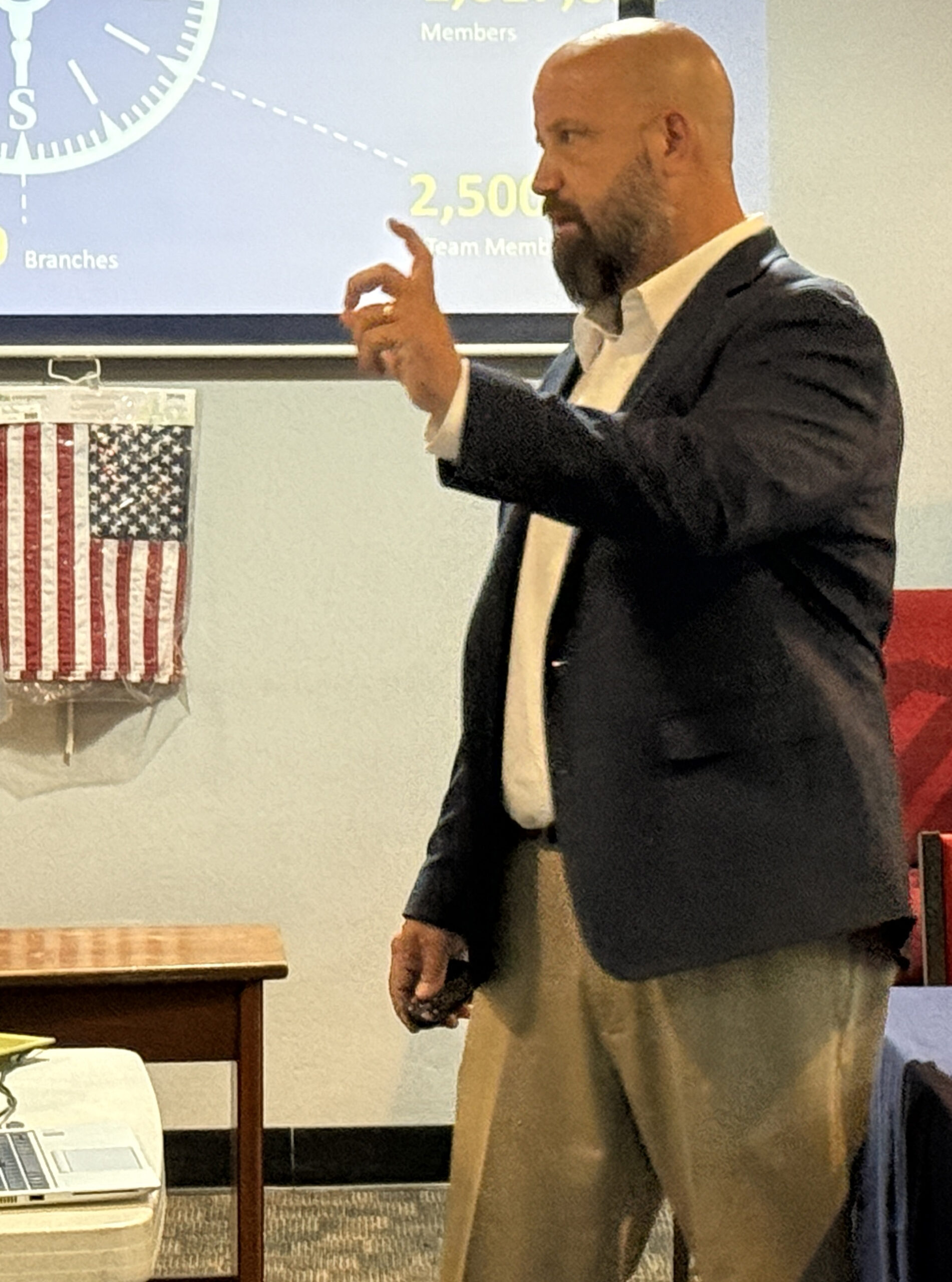
Michael Rathjen was a boy on a construction site with his father when an old-timer taught him geometry in about 20 seconds.
They were laying out a building wall. The man measured three feet one way, four feet the other, then pulled a tape between the two marks until it read five. That was it. That was the whole lesson.
“He taught me the Pythagorean theorem in 20 seconds,” Rathjen told the Keystone Heights Rotary Club on Wednesday, July 29. “That practical application, not to be dramatic, is a world changer.”
He had sat through the classroom version. A teacher had tried; it didn’t take. His father, who grew up in a group home in Texas and came up through a sheet metal roofing apprenticeship, handed him a tape measure instead.
That experience on the construction site taught Rathjen the value of technical education. His career is now focused on helping today’s students benefit from real-world learning.
Rathjen is vice president of school programs for VyStar Credit Union, a title that did not exist when he started and that almost no one else in financial services holds. His job is to build working bank branches inside high schools and hand them over to teenagers.
There are 20 of them now, including four in Clay County, one in Putnam and one at Bradford High School in Starke. The Bradford branch took roughly six years to land.
A slow yes
Rathjen is careful about how he describes the delay. “Turnover in leadership, and then at the school district level,” he said in an interview after the Rotary meeting. “And then some of this, unfortunately, does become, I’ll say political, just for simple definition.”
Districts have banking relationships. Board members have spouses. A credit union asking for a permanent storefront on a public campus is asking for something other institutions might want, and the friction is not always about students.
“Our approach has been that we’re here to complete one another, not compete for the school space,” Rathjen said. “We obviously compete in the marketplace.”
When the friction shows up, VyStar’s habit is to back off rather than push. “There’s plenty of need,” he said. So, the credit union keeps building elsewhere, keeps the relationships warm, and waits for the next superintendent or principal to take the meeting. At Bradford, the yes finally came in 2019, helped along by a longstanding connection between the superintendent at the time and VyStar’s leadership.
“Sometimes it takes that,” Rathjen said, “where you have to build that relational credibility.”
Timing helped. The district was fortifying its campuses, and when the new fencing went up the front office moved, leaving the old main office empty.
“It was perfect timing,” he said.
Bradford became a proving ground: the first VyStar school branch with a touch-screen kiosk and digital displays, and the first where the credit union let go of its own brand guidelines and used a school’s colors instead.
A shrink-wrap adhesive on the exterior brick wall carries the VyStar logo in Bradford red and black, wrapped around the school’s own core values: responsibility, believing, cooperation, respect and achieving. It reads as a mural more than signage. “You’ll see people taking pictures and stuff in front of it,” Rathjen said.
What the school gives up
Building a school branch costs VyStar about $260,000, and the credit union covers every dollar of construction. “It’s not like we just bring leftover furniture and start plugging stuff in and hope that it works,” Rathjen said. VyStar works alongside district facilities crews; elsewhere it has converted testing rooms and janitor closets into full storefronts.
The school’s contribution is space and a teacher, and the second one is the harder ask. The branch runs as a class period, scheduled over lunch so the student body can bank while the interns are working. One teacher is assigned to eight to 12 students in a system built around classes of 36.
“If you just look at it on paper, it’s like, why do I have this one teacher with these 12 kids?” Rathjen said. His answer, delivered to every new principal: “If you support those 12, they’re going to reach hundreds with finances.”
Bradford runs eight interns, one of the smaller programs. VyStar has since concluded 12 is the right number.
Getting one of those seats is not casual. Students apply, the school screens them for academic standing, and then comes a panel interview, intense, Rathjen said, for a 15-year-old, followed by the same background check, drug screening and onboarding VyStar’s full-time employees go through.
They are paid $15 an hour, a rate the credit union adopted roughly three years before the state minimum caught up, for a year-long internship they can start as sophomores and hold for up to three years. They work VyStar’s public branches on weekends, holidays and through the summer, and they run their own campus branch during the school day for course credit.
The numbers, and the ones that don’t count
VyStar had 223 interns this past summer, drawn from 20 high schools across nine school districts. More than 2,400 internships have been offered since the program started nearly two decades ago. Students have earned more than $6.5 million in wages.
Rathjen dwells on that last figure, because he thinks the entry-level rung has quietly been sawed off with the $15-an-hour minimum wage. “Why hire a 15-year-old at $15 an hour when you have to pay that minimum?” he said. “You’re more than likely going to hire maybe a 24-year-old.” Roughly half of VyStar’s school programs sit in Title I campuses, economically disadvantaged schools.
“Some of our students are making more money per hour than their parents.”
The credit union has hired more than 110 of its former student interns outright. About 70 are still there, scattered across 17 business units, lending, IT, marketing, business analysis, branch leadership.
Money moves back toward the schools, too. Every participating high school gets a debit card carrying its own logo, and VyStar returns five cents to the school on every swipe. The credit union capped the giveback at $10,000 when it started, then removed the cap after deciding there was no reason for one. It paid out about $50,000 last year and more than $130,000 to date, and this year is running 120 percent ahead of last year’s pace.
The money goes into principals’ discretionary funds, among the scarcest dollars in a school budget. “Just buying some breakfast sandwiches, they don’t have that for their staff, or to buy more tissue,” Rathjen said. “It’s just crazy how limited the funding is for unrestricted funds.”
VyStar reports exactly two figures on the program to its board. One is the giveback. The other is how many students received financial education, more than 20,000 last school year. Profitability, new accounts and transaction volume are tracked, Rathjen said, but they are not the scoreboard.
The lesson that sticks
There is a wrinkle Rathjen volunteers without being pressed. He runs a financial education program, yet financial education is not what the students say they got out of it the most.
He quizzes them on spending, saving, investing, insuring. The curriculum is real. But when he asks what they learned, they talk about something else: how to handle a disagreement with a coworker who happens to sit next to them in third period, how to run a business with people who don’t share their ideas, how to stand up and speak.
Pressed on the gap by a Rotarian, he didn’t dodge it. “It’s sticking,” he said. “It’s just not their biggest takeaway.”
That may be the more durable outcome anyway. Rathjen’s pitch to community groups leans on a line he attributes to no one in particular: if your vision is for a season, plant a crop; for 10 years, plant trees; for a generation, grow people.
His closing ask of the Rotary club was deliberately small. Serve on a school program’s advisory board. Speak to a class. Run mock job interviews. Volunteer at a reality fair. Or take on one intern.
“We sometimes unintentionally scare people off when we show the magnitude of our program,” he said. “One student. Just start one student at a time.”