Tinsler hoping for living kidney donor

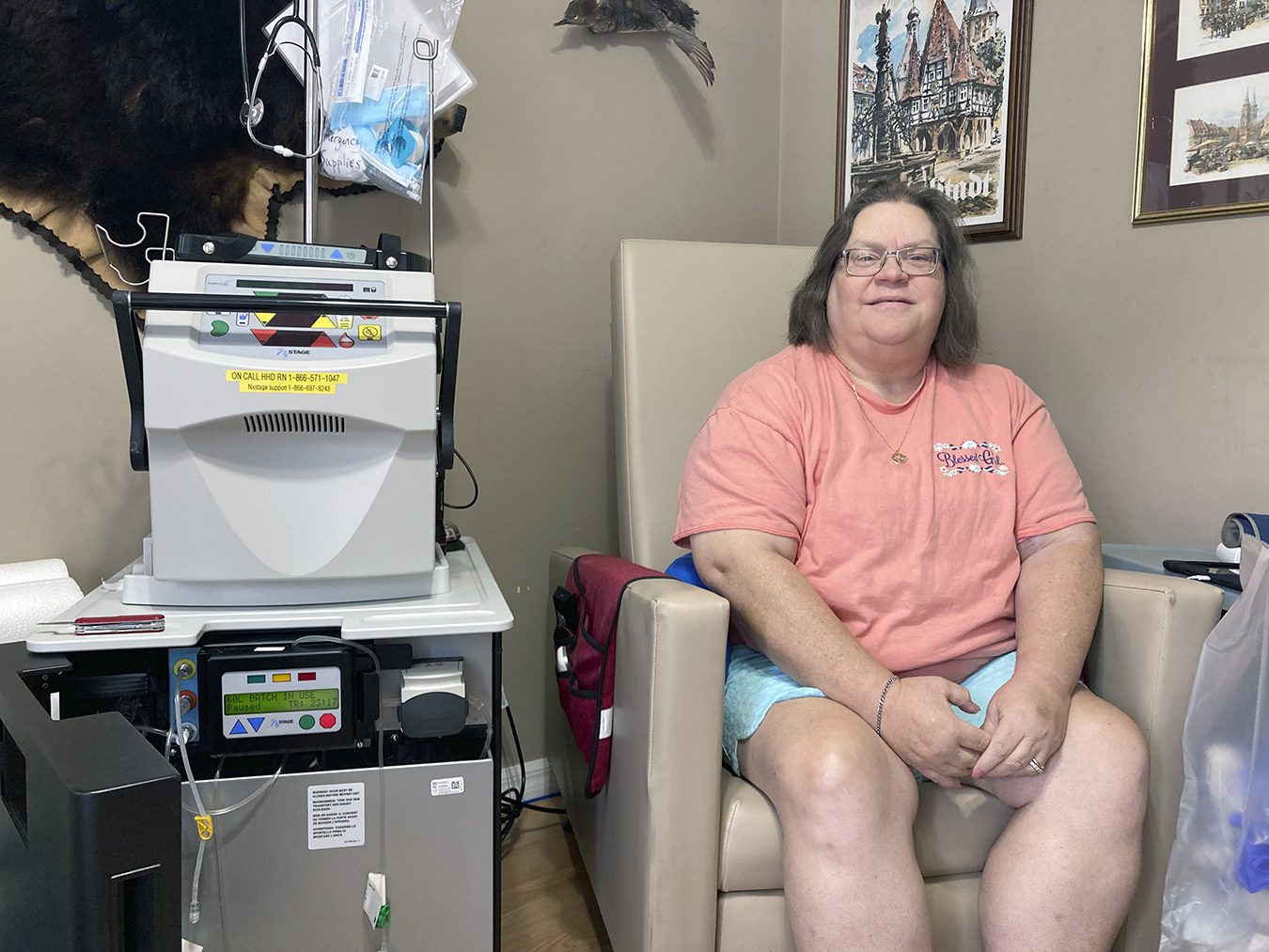
Julee Tinsler is pictured at home by the dialysis machine she uses four days a week for more than three hours each day. Tinsler is praying that a living donor will come through so that she doesn’t have to wait for a kidney from a cadaver, which could take five years. Photo by Cliff Smelley.

BY CLIFF SMELLEY

Telegraph Staff Writer

Julee Tinsler doesn’t want to wait for up to five years.

Five years, for Tinsler, would equate to more than 1,000 dialysis sessions, totaling more than 3,300 hours. Five years is how long it could take for her to receive a donor kidney from a cadaver.

“What I’m after is a live donor,” she said.

Tinsler, a Starke resident who once worked for the Bradford County School District (serving 14.5 years as its finance director), has already been undergoing dialysis for more than two years. The upside is that she has a machine at home, so she doesn’t have to go to a clinic. The downside is that she rarely has the energy to leave her home.

“The thing that frustrates me is the fatigue,” Tinsler said. “I want to go do things.”

The wife of John Tinsler, the career placement specialist at North Florida Technical College, encourages people to consider donating a kidney. She would need it to come from someone who’s blood type is O positive or O negative.

“This is totally zero cost to the donor,” Tinsler said. “My insurance will pay for the surgery and for the testing.”


Diagnosis, dialysis and transplant list

Doctors at first thought Tinsler might have congestive heart failure. She had been retaining fluid and underwent a heart cath in November 2020. As it turned out, she had no problems with her heart, but follow-up bloodwork in December 2020 revealed that her kidney function was in decline.

Tinsler, who was working for the State of Florida Auditor General at the time (she’s now on disability retirement), began hemodialysis in early 2021, after she got to a point in February where she couldn’t breathe because of her body’s fluid retention. That put her in the hospital.

“Over the course of about three weeks, they took off about 50 pounds of fluid,” Tinsler said.

Two weeks after she began hemodialysis (when the blood is pumped out of your body and into an artificial kidney, where it is cleansed), Tinsler felt worse. A doctor even told her that she looked worse. The hemodialysis catheter had caused an infection, so it was removed. Because of that, Tinsler began peritoneal dialysis earlier than she was supposed to. Peritoneal dialysis is when the filtering process occurs inside your body. A cleansing fluid enters and exits your body via a catheter inserted into your belly.

Tinsler said peritoneal dialysis, which took place at home, was successful from April 2021 until February 2022, when she woke up one morning with excruciating pain in her abdomen. She underwent antibiotic treatment off and on for six weeks.

“Ultimately, they decided that the catheter was infected,” Tinsler said.

The peritoneal catheter was removed. Tinsler began hemodialysis again. Three months later, she had another catheter inserted for peritoneal dialysis, but that type of dialysis wasn’t working for her.

“It just was not pulling off the fluid,” she said. “You could put fluid in, but you couldn’t get fluid out.”

 Doctors determined that Tinsler had peritonitis (inflammation of the membrane lining the abdomen), which was preventing peritoneal dialysis from working. She had no choice but to go back to hemodialysis.

Tinsler didn’t want to keep making trips to a clinic, so she, John and her father, Wallace Wise, underwent training so that she could do dialysis at home.

“It takes six weeks to train,” Tinsler said. “It can be done by yourself, but it is highly recommended that you have somebody there with you — a buddy. By and large, my buddy is my dad.”

Dialysis occurs four days a week, with each session lasting approximately three hours and 15 minutes.

“It takes about 30 minutes to set it up and break it down, so you’re talking four hours a day, four days a week,” Tinsler said.

Tinsler tried unsuccessfully to get put on the Mayo Clinic’s kidney transplant list. She was encouraged to try getting on the list at Tampa General Hospital. She went through a bit of an ordeal because of the earlier suspicions of congestive heart failure and had to undergo a stress test and meet with a Tampa General cardiologist, but in the end, she was approved for placement on the hospital’s transplant list.


Living donor

To donate a kidney to someone, a person must meet the blood-type requirements and be in good overall health.

If you’d like to see if you could be a donor for Tinsler, you can go to tgh.org/livingdonorform.

“You answer the questionnaire. It tells you whether or not they even want to look at you as a possible candidate,” Tinsler said, adding, “This is totally anonymous. I would love to know if you did it, so I can follow up on it, but I have no access to your medical history or anything.”

You can also call 813-844-5669 or send email to [email protected].

Aside from the fact that a living donor could spare Tinsler waiting five years for a cadaver kidney, the benefit of a living-donor kidney, according to the Tampa General website, is that there is less chance of rejection and a better chance of long-term success. Also, a kidney from a living donor usually functions immediately. Cadaver kidneys may require dialysis until they begin functioning properly.

Minimally invasive laparoscopic surgery is performed on a living donor. It requires just a small incision.

“For me, it’s much more complicated,” Tinsler said. “They actually have to cut me open.”

According to the National Kidney Foundation, donors will stay in the hospital for 1-3 days following surgery and can resume normal activities and exercise 4-6 weeks following surgery. Donors can live their lives as normal with just one kidney. The remaining kidney will increase in size to compensate for the loss of the other kidney.

Tinsler said she knows several people with only one kidney, including her mother-in-law and a friend, who were both born with only one.

“They didn’t know they had only one until they were adults,” Tinsler said. “They had no clue.”

A kidney from a living donor, according to the National Kidney Foundation, can last an average of 15-20 years.


Waiting

Longtime Bradford educator/administrator Randy Whytsell has been through what Tinsler is going through now. Tinsler said in talking with Whytsell, he reminded her to do the things she’s supposed to do for the benefit of her health and to keep in mind that the journey she’s on isn’t a sprint. It’s a marathon.

It’s good advice because she doesn’t know when — or if — a living donor will come through. She doesn’t know how many more sessions of dialysis she has to endure. All she can do is wait it out, but she admitted the waiting is easier because of the number of people who are praying for her and keeping her in their thoughts. Tinsler said, “It has been unbelievable how many people will just randomly text me and say, ‘Thinking about you. Praying for you.’”

The thought of so many prayers and positive thoughts have helped her through some of the rough times, like when she was sick with peritonitis.

Tinsler said she’s had people ask her if it’s OK if they put her onto their church’s prayer list. Her response is always, “Yes. Please put me on the prayer list. I would greatly appreciate that.”

Aside from the thoughts and prayers, Tinsler is thankful for the support of her family, especially her father — her main dialysis buddy — and her husband.

“John has just been incredible through this,” Tinsler said. “He’s had to pick up a lot of things that I would normally do.”