BY DAN HILDEBRAN
Union County Commissioners discussed ramping up code enforcement during their March 17 meeting after a resident complained that Providence-area landowners were renting tiny houses through Airbnb.
In a March 4 email to County Building Inspector Wilson Whidden, P. Baker identified four parcels owned by Carol Govinda and Raymond-Balyas Krsna Jlvani off County Road 241 and claimed someone was operating an illegal campground on the lands.
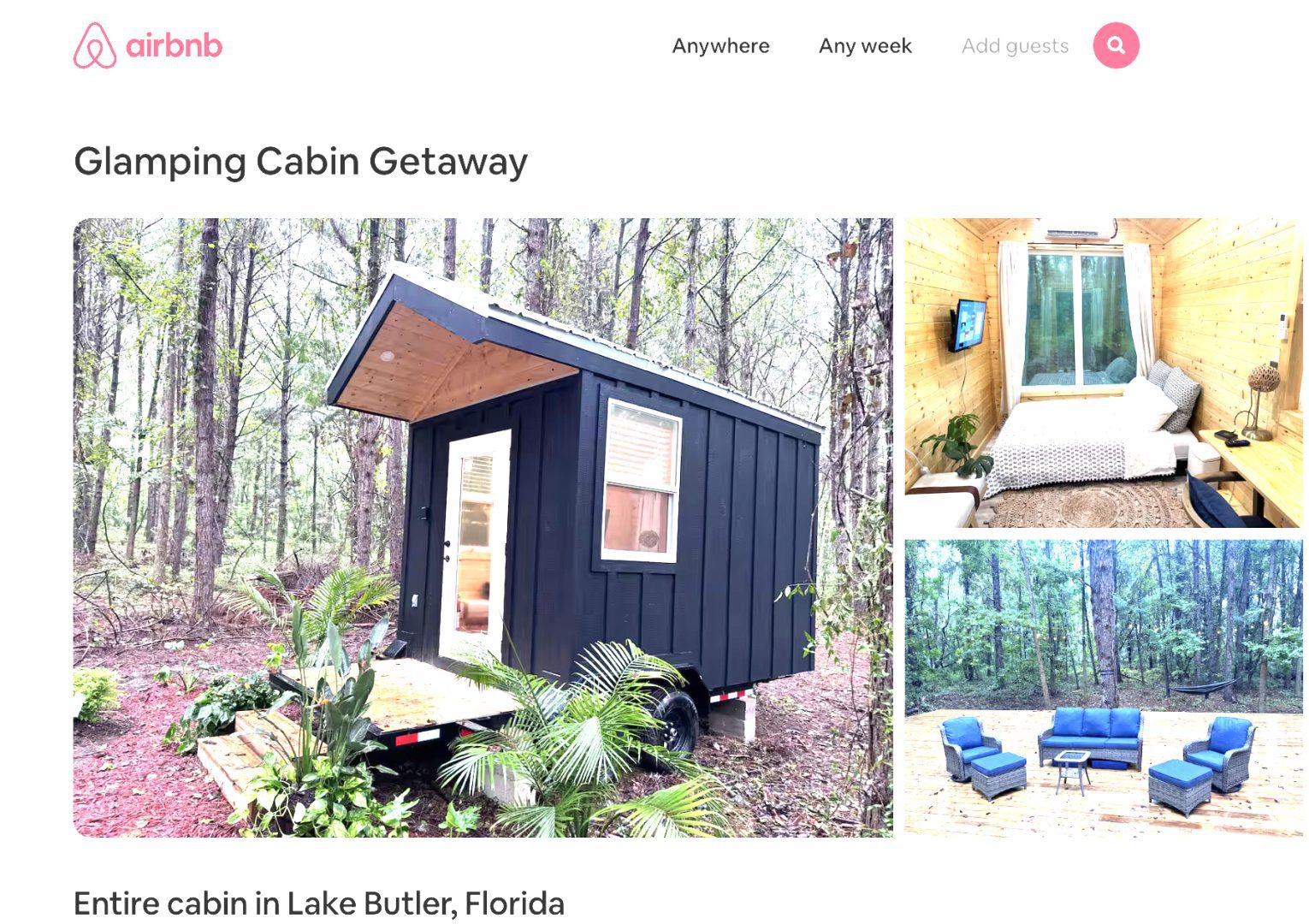
“The property is now filled with small structures on trailers that they build themselves,” the complainant wrote in the email. “It appears they are producing these structures faster than they can sell them, so instead, they rent them out by the day, effectively operating as a commercial campground. What started as just a couple of structures has now grown into nine or ten in a very short time.”
Baker said the temporary rentals have increased unwanted traffic “with out-of-towners searching for their camping spots at all hours—including very late into the night—disrupting the quiet nature of the area.”
Glamping cabin getaways
At press time, the landowners listed 16 rentals on Airbnb, described as glamping cabin getaways and tiny homes. The rentals are located in Lake Butler, Alachua, High Springs, and Fort White, with most of the rentals in Lake Butler.
During the March 17 meeting, County Attorney Russell Wade told commissioners the complaint points to a long-debated subject in the county—whether commissioners should establish a code enforcement apparatus.
“Are we prepared to get into the code enforcement business, and if so, do we want to enforce it by investigating this particular complaint?” he asked. “It’s really a budgetary resource question, I think, more than anything.”
The attorney added that while it is easy to demand compliance with the county’s land use and zoning rules, enforcing those demands would be expensive and time-consuming without a formal code enforcement structure that utilizes a magistrate to adjudicate cases.
‘Once they caught, they quit doing it’
“Ultimately, if someone doesn’t voluntarily come into compliance, we can adopt the Florida Statute that allows for what’s called a quasi-judicial process where we have a magistrate instead of having to take everything up to the big court,” he advised.
Wade said that taking code enforcement cases to county or circuit court is costly and can be drawn out over long periods of time.
“It’s rules of evidence,” he said. “It is discovery. You have to prepare for full-blown court every time. In a quasi-judicial with a magistrate., you don’t have the hearsay rules, you don’t have the liberal rules of discovery that you have in court.”
Wade warned commissioners that once word got out that the county was serious about code enforcement, they could be deluged with complaints.
The lawyer also reminded commissioners that previous county commissions had instructed him not to pursue code violations.
Commissioner Mac Johns said that in many cases, once violators know they have been discovered, they cease the illegal activity.
“A lot of them know (they are violating codes), and they just do it until they get caught, and then once they get caught, they quit doing it,” he said.
Commissioners agreed to send a county representative to the properties with the alleged violations and, if the complaint is verified, to write to the property owner.
In the meantime, they instructed Wade to investigate setting up a formal code enforcement process for the county.