
Drone campus, foreign-backed industrial hub both still need federal OK, Eifert tells Rotary
BY DAN HILDEBRAN
Dan@BcTelegraph.com
Two developers have pitched sweeping plans for Keystone Heights Airport, one a defense-oriented drone campus and the other an industrial hub its backer says could someday employ thousands, but neither can move forward until the Federal Aviation Administration weighs in, and that has not happened yet.
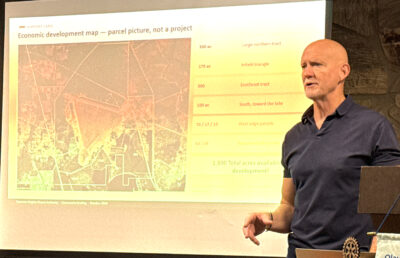
Jim Eifert, chair of the Keystone Heights Airport Authority, gave the Keystone Heights Rotary Club an update on the proposals Wednesday, stressing that nothing has been approved.
“Don’t take from this briefing that there are these things that are going to happen,” Eifert said. He estimated the chance that either project is built in its entirety at less than 10%, though he said portions could proceed depending on what the FAA allows.
The two proposals are separate. Silicon Beach, led by Jacksonville startup investor Jason Engelhardt, wants to build what it calls the Keystone Heights Innovation and Defense Campus on about 100 acres in the airport’s northeast corner. The Erisha Group, headed by Indian entrepreneur Dr. Darshan Rana, wants about 100 acres on the Bradford County side of the airport, with ambitions to grow to 700 acres.
Both submitted packages to the FAA this spring seeking preliminary approval for aeronautical land use. Neither has a ground lease.
A drone campus next to Camp Blanding
Eifert said Silicon Beach is focused on unmanned aerial systems, autonomy research and aerospace manufacturing. Engelhardt has worked with at least 50 companies in the drone industry and envisions about a dozen, most of them small, operating on the campus, Eifert said.
The first phase would cover roughly 50 acres and could include a building of up to 1 million square feet, with a second phase to the south. Eifert said the site sketches are notional and would likely shift south to stay clear of the approach to Runway 11-29. No surveys or permits have been drawn.
The selling point is the location, about a quarter mile from Camp Blanding’s ranges. Eifert said drones could cross directly into the military reservation’s airspace without flying over the community.
“The other great thing about that system is it would really have no impact on the local community in terms of noise or overflight,” he said.
Eifert pointed to the Drone Crucible held at Camp Blanding last week by the U.S. National Drone Association, the third such event at the post. During the exercise, a drone launched from a boat on Lake Lowry and struck a pair of surplus Electra aircraft parked at the airport as a demonstration, he said.
An industrial hub with big numbers
The Erisha Group’s talks with the airport predate Eifert’s time on the board and began with his predecessor as chair, David Kirkland. Eifert said the company has built a similar innovation hub in the United Arab Emirates and has looked at sites in Portugal and Botswana, and that Keystone Heights is its planned North American location.
The company’s plans include aircraft maintenance, repair and overhaul hangars in the runway infield, along with aerospace manufacturing, avionics, aircraft painting and storage, aviation training, drones and hydrogen battery cell development.
Eifert said the company has talked about an initial capital investment of $400 million and up to 600 direct jobs, and about 15,000 jobs across four phases on 700 acres. It also wants the runway lengthened.
“I never see that happening,” Eifert said of the 15,000 figure, adding that he sees no FAA appetite for a longer runway. He said 100 jobs from the first 100 acres is “definitely likely.”
Both developers are eyeing state incentives for projects that bring 100 or more jobs to rural areas, he said, and Eifert said tariffs have made building inside the U.S. more attractive to foreign companies like Erisha.
He said Erisha prefers the Bradford side because permitting there is easier and cheaper than in Clay County.
Waiting on the FAA
Eifert said the airport depends on the FAA for about 90% of its funding, with about 8% from the Florida Department of Transportation and 2% from the airport itself. That money comes with about 40 federal “grant assurances,” including a requirement that development on airport property be aeronautical, a condition tied to the federal government’s 1947 transfer of the former World War II training base to the city of Keystone Heights.
The question before the FAA is whether drone manufacturing and related industries, some of which would not use the runways, count as aeronautical.
Even with FAA approval, both projects would still need an amended airport layout plan, federal airspace review, environmental studies, leases and local permits. “It will take years, no doubt,” he said.
Runways, water and roads
The airport covers about 1,300 acres and straddles the Clay-Bradford County line. It is the only airport serving either county. It has about 60 tenants, most of whom rent hangars, and earns money only from leases and fuel sales.
Its two runways are each about 5,000 feet long, too short to ever make the airport a commercial hub, Eifert said. A state grant of more than $1 million will widen Runway 11-29 from 75 to 100 feet so MHD Rockland, a P-3 aircraft operator at the airport, can keep working while Runway 5-23 closes for about six months of repaving. Meanwhile, Eifert said, the FAA recently decided to narrow Runway 5-23 to 75 feet.
Development is also limited by a lack of utilities. The airport relies on wells and septic tanks. A study five years ago put the cost of extending Clay County Utility Authority lines a little more than a mile from the RV resort at about $6 million. Eifert said that has likely doubled to $11 million to $12 million. He said the Erisha Group has proposed building its own sewage facilities.
Eifert also said the airport is updating its 10-year airport layout plan, a process that has taken more than a year, and predicted aviation will change more in the next decade than it has in the last century as autonomous aircraft and electric vertical takeoff and landing vehicles arrive.
The retired leader of the Florida National Guard added that other smaller projects are in various stages of talks and that he listens weekly to two or three piches, all of which, so far, have not panned out.
“You have to kiss a lot of toads before you find your prince,” he said.