BY DAN HILDEBRAN
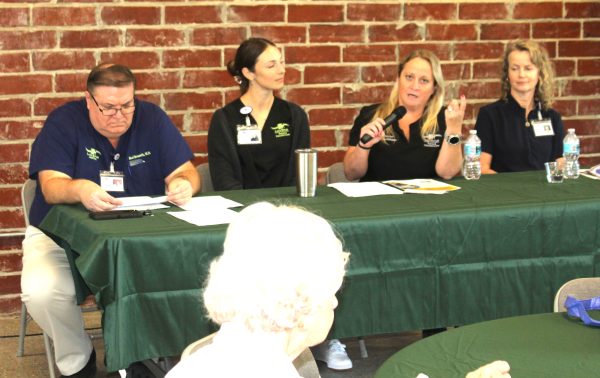
The October 1 meeting of the Union County Impact Initiative focused on senior health issues with a panel of health providers from Lake Butler Hospital and Lake Butler Family and Pediatric Clinic.
Noel Braseth, MD, Holly Garver, APRN-BC, Christy Thomas, RDN, LD/N, and Angelica Kraus, PA. discussed nutrition, diabetes, end-of-life planning and other topics.
Braseth identified the three most significant health risks to seniors as cardiovascular events, cognitive decline, and falls.
“A fall can be devastating,” he told the crowd of around 75 at the Hal Y. Maines Community Center in Lakeside Park. “Breaking a hip means rehab for life.”
Garver and Kraus emphasized the importance of regular screenings, including bone density tests, cardiovascular checks, and cancer detection, referring to them as “non-negotiable.”

Braseth advised patients to prepare for provider visits and not to be shy about asking questions.
“Folks have a limited amount of time to spend with you in the examination room or in the emergency room,” he said. “So, sometimes it’s good to come in with a list and prioritize your list. Probably, realistically, one or two problems are going to be able to be addressed thoroughly on that visit.”
“And remember that there’s not a dumb question,” he added. “If you don’t get your questions answered, you’re going to leave the facility feeling like you’re missing something.”
Thomas went over the USDA’s MyPlate.gov model for a healthy diet, recommending a plate that is half vegetables, a quarter protein, and a quarter starches.
She also provided a simple formula for daily protein intake.
“Take your weight, divide by two – that’s grams needed daily,” she advised. “We find that a lot of older Americans do not— a lot of Americans, period, don’t get enough protein. We see it in the hospital all the time. People come in, and their protein’s depleted.
The panelists also emphasized the importance of making social connections to combat depression and cognitive decline.
The panel also spoke at length about end-of-life planning, distinguishing between palliative care, which aims to optimize quality of life for individuals with chronic conditions, and hospice care, which focuses on comfort in the final stages of life.
Braseth reassured the audience that advance directives are flexible tools designed to ease the burden of decision-making on family members.
“It’s not ‘do not resuscitate’ forever,” he explained. “You can change it.”