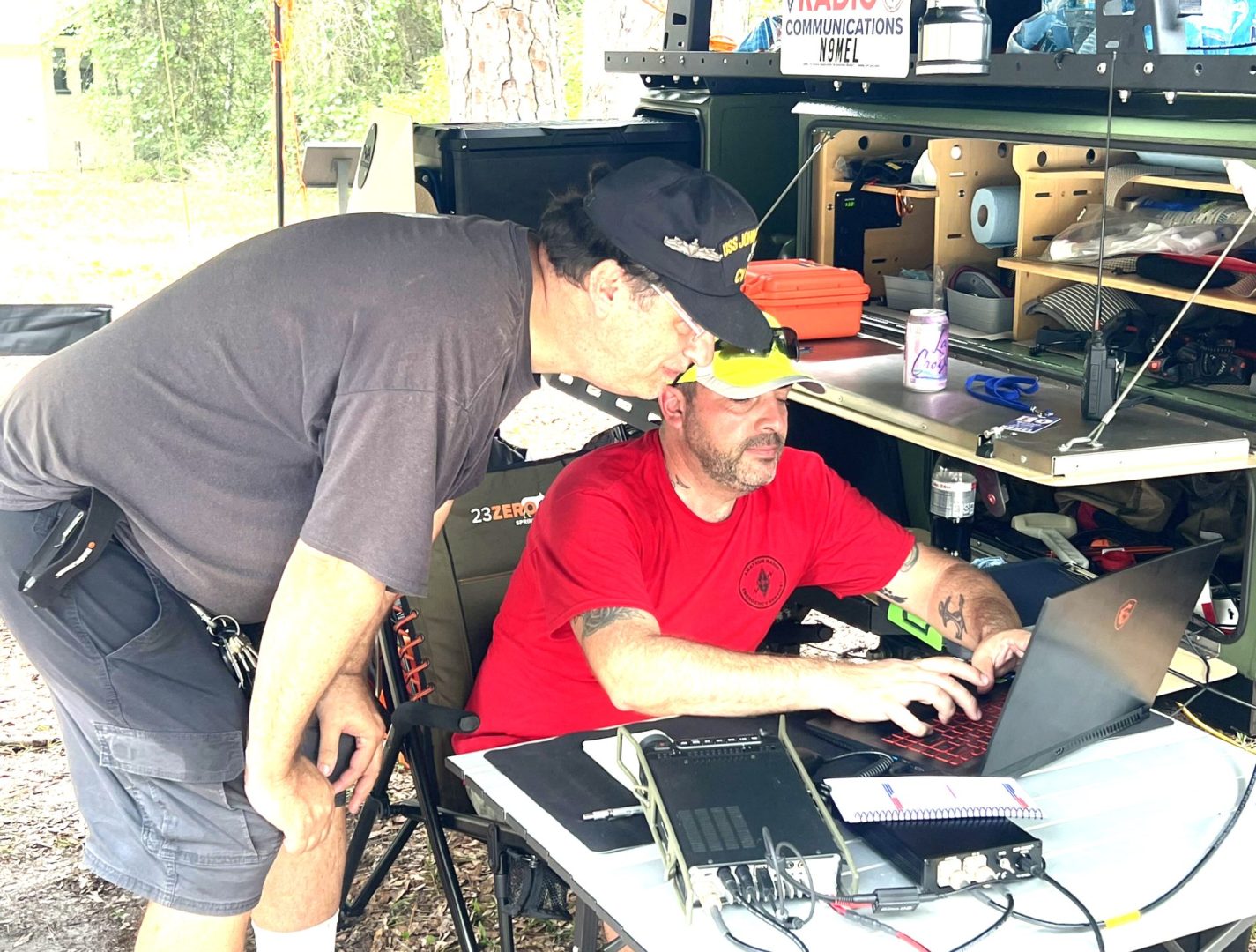
When Disaster Strikes, Clay County’s Amateur Radio Club Answers the Call -Starke City Commissioner helps lead group

Marshall Lowry and Chuck Helverson

By Jenn Samsel

Special to the Monitor

On Saturday, June 28, Camp Chowenwaw Park in Clay County hosted the ARRL Field Day. The event lasted for 24 hours as amateur radio operators gathered to achieve essential goals and test their equipment in preparation for potential disasters, such as the upcoming hurricane season or an electromagnetic pulse (EMP) event.

In 1973, the ARRL Field Day was established, and the Orange Park Amateur Radio Club was founded during this time as well. Each year, the club promotes this event as part of its participation point system.

The club holds an annual field day that coincides with the start of hurricane season. During this event, members test their radio equipment to ensure they are prepared for any emergencies that may arise during the season. It is essential to understand how quickly communication methods can be restored for first responders in the event of a storm disrupting traditional communication lines.

“For the event, we come out and set up our equipment as if we were setting up for a disaster. Then we work for 24 hours straight, trying to make as many contacts as possible throughout the United States and the rest of the world. We ensure our equipment is functioning and ready to go for the needed hurricane Season,” said Scott Roberts, who is a Starke City Commissioner and the Assistant Emergency Coordinator for Clay County Amateur Radio Emergency Service.

At the event, they set up a specific satellite antenna that is used to communicate with all the satellites. Even when the International Space Station passes by, they can communicate with it.

The field day consists of three parts:

  1. Analog, also referred to as single-sideband and voice communications.
  2. CW, which stands for Continuous Wave, is a form of Morse code; today, it is often transmitted using a computer.
  3. Digital mode, which allows communication with other stations. In this mode, the computer can detect signals in the noise that are beyond the range of human hearing.

“I am here at Field Day to also set the network up and to assist other operators in getting their stations up and running and to educate not only other amateur radio operators who are out here for their very first time. But any members of the public who happened to wander through and have never been exposed to amateur radio. In today’s digital age, even cell phones are still relevant, as the older types of communications, such as shortwave, remain relevant in the world. Whether it be for communications or scientific principles,” said Charles Helverson, field day chairman and treasurer for the Orange Park Amateur Radio Club.

“Now is the perfect time to get your amateur radio license. There’s a lot of interest in it, and we would love for them to come out and contact us,” said Roberts.

Visit ClayAres.org to obtain your license and learn more information.