Dan@BcTelegraph.com
Keystone Heights City Council set the ceiling for next year’s property tax rate at 3.7902 mills Monday night, while warning residents that a proposed state constitutional amendment on the November ballot could force deep cuts to community events, from Fourth of July fireworks to the Christmas parade.
The maximum millage rate, adopted unanimously, is the highest rate the council can consider when it adopts the fiscal year 2026-27 budget in September. It is not the rate taxpayers will necessarily pay. The city’s current rate is 3.6073 mills.
“Just because we are advertising a maximum millage rate does not mean that will be the final rate,” Councilman Ryan Knight said. “We’ve done this every year.”
City Manager Jamie Booth said the figure follows a 2012 city budget policy that caps the maximum rate at 10 percent above the previous year’s property tax revenue. Last year’s rate should bring in $383,374 this year, he said, and the 10 percent cushion adds $38,337. Calculated against the city’s newly certified taxable value of $111,264,832 — up from a June estimate of about $108 million — that works out to 3.7902 mills. The rollback rate, which would generate the same revenue as last year, is approximately 3.4456 mills, Booth said.
The council also set its budget hearings for Monday, Sept. 14, at 6 p.m., with the final hearing Sept. 21, when the council will adopt the millage rate and budget. The maximum rate must be reported to the Clay County property appraiser by Aug. 4 for inclusion on TRIM notices mailed to property owners.
10% budget reduction exercise required
City Attorney Rich Komando told the council that new state legislation adds hurdles this year. Counties and municipalities must go through a 10 percent budget reduction exercise, he said, and adopting a millage rate up to 10 percent above the rollback rate now requires a supermajority vote; anything higher requires a unanimous one.
Hanging over the discussion was a proposed amendment headed to voters in November that officials said would restrict how cities spend property tax dollars, limiting them to a state definition of core services that excludes arts and community events.
“It’s not even that you won’t have the money,” Komando said. “You’re not going to be allowed to spend the money.”
Budget cuts would strain events
Councilman Dan Lewandowski said he has been talking with local nonprofit leaders about civic organizations stepping up to keep traditions like the Fourth of July celebration alive if the measure passes. Todd Beals, speaking from the audience, cautioned that groups like the Rotary and Friends of Keystone bring in only $8,000 to $10,000 a year and fund scholarships with it, while the city’s two annual fireworks shows cost about $30,000 each.
“Everybody says Keystone is our Mayberry,” Beals said. “If we are not providing those parades, those spring fests, those things like that, we’re really doing nothing anymore.”
Knight urged the council to build the coming budget on a worst-case revenue assumption and said he would vote against any cuts to the city’s infrastructure fund or staffing, pointing to an audit showing the city has already cut operating expenses about 30 percent in recent years. Mayor Nina Rodenroth called for a workshop to revisit the city’s strategic plan in light of the financial threats.
Ludwig pitches street improvements
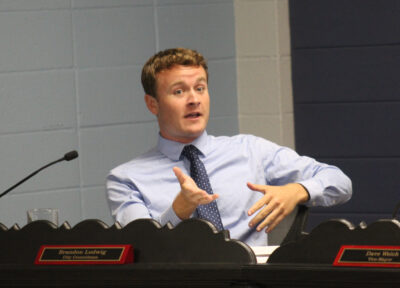
In his first budget cycle, Councilman Brandon Ludwig pitched two infrastructure proposals: a roughly $25,000 street striping effort he dubbed MAP — the Marking Assessment and Painting Project — targeting faded markings on Nightingale, Orchid, Lakeview and Pecan, and prioritizing a sidewalk along the Nightingale-Sunrise corridor with a placeholder of up to $100,000.
Booth said striping should become a regular part of a capital improvement plan that budgets about $200,000 a year for roads. On the sidewalk, he said the city has $45,000 budgeted for design but is in talks with Clay County about a partnership that could skip most design work and move straight to construction of the half-mile route, estimated at $100,000 to $120,000. The path would connect to a shopping center just outside city limits where a new Winn-Dixie is set to open.
“I’d much rather get $45,000 in concrete on the ground than just a design,” Booth said.
Welch wants lower speed limits
In other action, the council voted to join the North Florida Economic Development Partnership at $2,500 in annual dues. Booth said membership positions the city to seek designation as part of the Northeast Florida Rural Area of Opportunity in the 2028 cycle, opening the door to no-match state grants — including paving grants that have run as high as $600,000 in other rural communities.
The council also awarded a $21,000 contract to Air Innovations, the low bidder among three, to replace two rooftop air conditioning units at city hall that are more than 20 years old. Lake Area Heating and Air bid $21,250 and Lloyd’s Heating and Air bid $28,892; the city had budgeted $25,000.
During closing comments, Councilman Dave Welch renewed his push to lower the speed limit on State Road 21 through downtown from 30 to 25 mph, a change he said would cost drivers about 10 seconds but improve safety; the Florida Department of Transportation, which controls the road, is studying the request. Council members also celebrated a record Fourth of July, with the holiday 5K drawing 581 runners — up from 106 in 2020 — and an estimated 1,500 to 2,000 people at the fireworks show.